Heart Thursday| The Gilded Margin
Being back in Utah always brings something to the surface.
Maybe it’s the mountains. Maybe it’s being surrounded by family. Maybe it’s the way familiar places remind us of the people who should still be here.
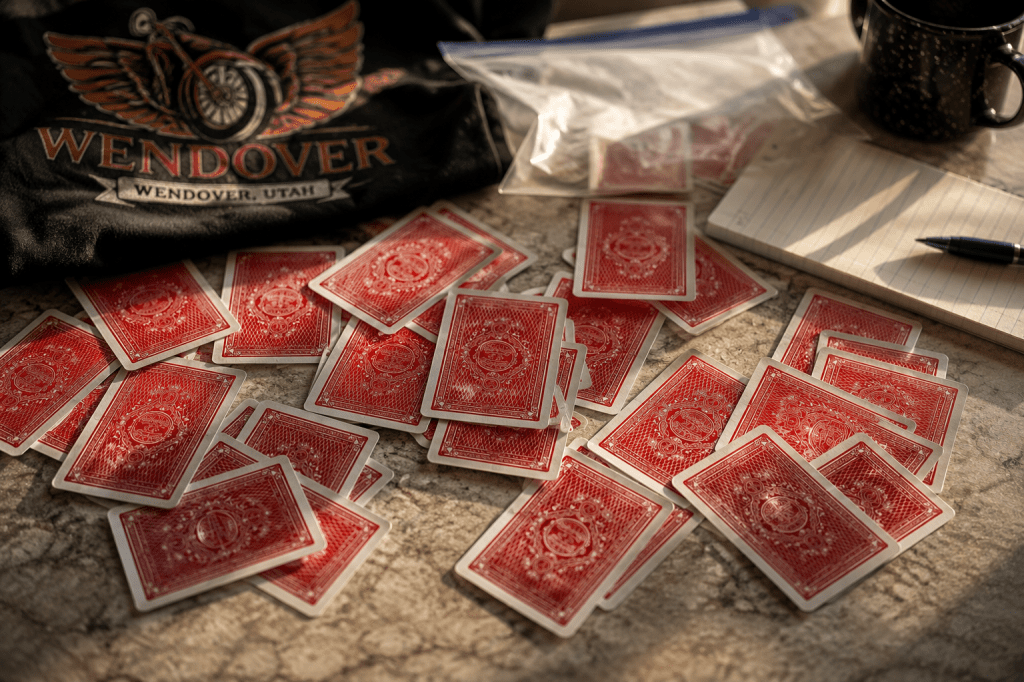
This trip, for me, it was a t-shirt.
A black Wendover motorcycle shirt that belonged to my grandma.
I’ve worn it countless times over the years. Before my grandparents passed away, it was simply one of my favorite shirts. I liked the way it fit. I liked the design. It was comfortable, familiar, and easy to throw on. There was nothing symbolic about it. It was just a shirt. But grief has a way of changing ordinary things.
Now, every time I wear it, I think about both of my grandparents. Without intending to, the shirt became a memorial. Not because I decided it should. Not because it sits in a display case. Not because it was carefully preserved. But because love attached itself to the fabric after loss.
As I packed for this family reunion and pulled it from my closet, I found myself feeling guilty. Not because I had forgotten them, but because I hadn’t memorialized them in the ways I thought I should.
I haven’t planted a memorial garden. I haven’t created a dedicated tribute. I haven’t built something permanent in their honor. Life kept moving, and somewhere along the way I convinced myself that meant I wasn’t remembering them enough. Yet here I am, wearing my grandma’s shirt and thinking about them both as I sit under the covered patio of my aunts house watching a storm roll in. My grandpas favorite past time. It’s ironic since his time has passed. I sorry in advance for the dark humor.
Maybe remembrance doesn’t always look the way we expect it to. Maybe memorializing someone isn’t always something we build. Maybe sometimes it’s something we carry.
Every family has traditions.
Ours are woven into the land and into the people who continue returning to it year after year.
We have horseshoe tournaments that somehow become serious competitions. Poker runs that take us through the mountains and back roads. Ranges set up on the back of the property. Family recipes that somehow taste exactly like childhood. Mud volleyball games that leave everyone laughing and covered in dirt. My personal favorite, horse trough baptisms for the newest members of the family. And this year, a projector screen has been set up outside for a kids’ movie night beneath the Utah sky. Which might just become my new favorite tradition.
To someone else, our traditions might seem unusual. But every family has its own language. It’s own rituals. Its own way of saying, you belong here.
As I’ve walked around this week, I’ve noticed things I never paid attention to before. The rooms that felt enormous when I was a child seem smaller now. The spaces I once explored with wonder look different. The adults I thought had all the answers seem more human. The children are growing up. The generations are shifting. Some of the people who built these traditions are no longer here to participate in them. And somehow, soaking all of this in has been transformational. It’s made me realize how incredibly short and fragile life really is.
The older I get, the more I understand that none of us are promised tomorrow. The people we love won’t always be here. The traditions we cherish survive only if someone chooses to continue them. The stories disappear if we stop telling them.
Growing up, there were pancakes and strawberry milk. There were motorcycles and four wheelers. There were adults laughing around a bonfire long after dark. There were stories being told that I wasn’t old enough to fully understand. There were board games every night. Cards spread and dice rolling across tables. The sounds of laughter drifting through the house long after bedtime.
One of my strongest memories is of my grandma sitting at the table playing pinochle. As a child, I didn’t understand the game. I didn’t pay attention to the rules. What mattered was knowing she was there. Comfortably settled into her chair, surrounded by family, laughing and talking with the people she loved. At the time, I thought those moments would last forever. That this was my normal for the rest of my life.
Now I understand they were building the foundation of what family would come to mean for me like fishing poles and family gatherings after church. Ordinary moments that didn’t seem important at the time. I didn’t know those moments would someday become treasures. I didn’t know one day I would wish I could step back into them, even for a few minutes.
I didn’t know grief would teach me the value of ordinary days.
While journaling this week, I found myself thinking about traditions like Día de los Muertos, where people intentionally remember those who came before them through stories, food, photographs, and shared experiences.
Maybe that’s what family reunions really are.
Not just vacations. Not just gatherings. But acts of remembrance. Remembrance like every horseshoe game, family recipe, story retold for the hundredth time, and children running through the same places their parents once explored.
It’s all memory work. It’s all legacy. It’s all a way of carrying those who came before us into the future.
As I look around this year, I see children gathered beneath the projector screen for movie night.
I watch them run through the same spaces where I once played.
I hear laughter echoing through rooms that somehow seem smaller than they did when I was young.
And I wonder which moments they’ll remember decades from now.
Will it be the movie playing against the night sky?
The horseshoe tournaments?
The mud volleyball games?
The family recipes?
The board games around the table?
Will they remember the adults the way I remember mine?
The truth is, they probably won’t realize they’re making memories while they’re living them.
Neither did I.
This trip has reminded me that family matters.
Not because every family is perfect. Not because every relationship is easy. But because the people who love us help shape who we become.
Every tribe looks different. Some are connected by blood. Some by marriage. Some by friendship. Some by choice.
But whatever your tribe looks like, there is something sacred about belonging.
There is something sacred about returning to the people and places that helped make you who you are.
As I sit here wearing my grandma’s black Wendover shirt, I realize that maybe I’ve been memorializing my grandparents all along.
Not through gardens.
Not through monuments.
Not through plaques or candles.
But through stories.
Through traditions.
Through gathering.
Through remembering.
Through carrying pieces of them with me wherever I go.
Tonight, I’ll raise a shot of tequila for my grandpa and throw it back with a lime and some salt.
Not out of sadness.
But out of respect.
Out of gratitude.
Out of love.
Because I finally understand something I didn’t when I was younger.
Love doesn’t end when someone dies. It becomes memory. Memory becomes tradition. And tradition becomes legacy.
For years, I thought memorializing someone meant creating something permanent. Now I think memorializing someone can be much simpler. It can be showing up, telling their stories, wearing one of your favorite shirts that was once your grandma’s, sharing a drink in their honor or choosing to be one of the tribe members who continues carrying what they left behind.
As I look around at the younger generations running through the same spaces I once explored, I realize something else.
One day, they will look back on these gatherings the way I do now.
One day, they’ll remember the adults sitting around the bonfire.
The laughter.
The stories.
The traditions.
And whether I feel ready or not, I am no longer one of the children creating memories. I am one of the adults helping create them. One of the people they will someday remember. One of the benchmarks they will use for their own reflections. One of the keepers of stories. One of the carriers of legacy.
Maybe that is what growing older really is.
Learning that love, grief, respect, and memory are not separate things. They are threads of the same rope connecting generations together. And our responsibility is not to hold that rope forever. It is to carry it for a while, honor those who handed it to us, and then pass it on to the next hands waiting behind us.
For the first time, I think I understand what that looks like.
And tonight, as I raise a shot of tequila to my grandpa and smile at the memory of my grandma playing pinochle at the table, I’ll be grateful to be part of the tribe still carrying the story forward.


Leave a Reply