When most people think about caring for reptiles, they think about food.
What should they eat?
How often should they eat?
Do they need supplements?
Those are all important questions, but they’re only part of the picture.
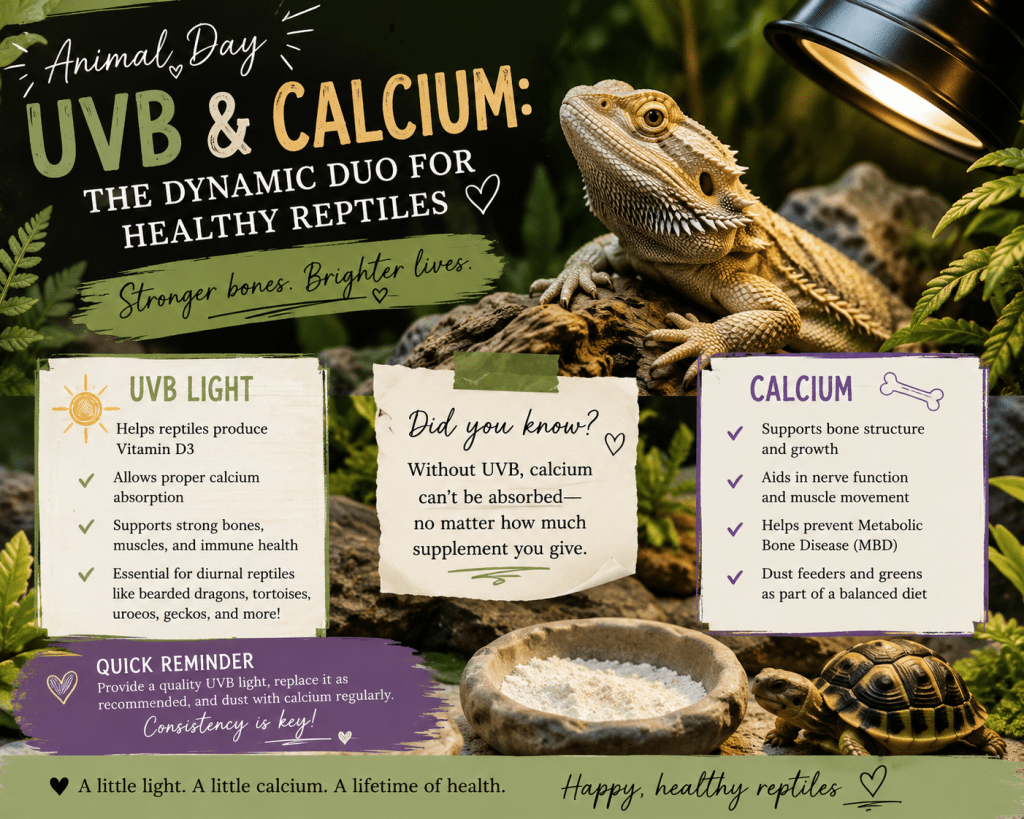
One of the biggest misconceptions in reptile keeping is that providing calcium alone is enough. In reality, calcium, UVB lighting, heat, hydration, and nutrition all work together. If one piece is missing, the whole system can begin to fail.
UVB: The Sunshine Your Reptile Can’t Live Without
In the wild, reptiles spend much of their lives exposed to natural sunlight. One of the most important parts of that sunlight is ultraviolet B (UVB) radiation.
UVB allows many reptiles to produce vitamin D₃, which helps their bodies absorb calcium from the food they eat.
Without enough UVB—or another appropriate source of vitamin D₃—a reptile can consume plenty of calcium and still be unable to use it effectively.
Over time, this can lead to serious health problems, including metabolic bone disease, weak bones, deformities, poor growth, muscle weakness, and difficulty moving.
Not Every Species Needs the Same Amount
Every species has different lighting requirements.
Russian Tortoises
Russian tortoises thrive with strong UVB lighting because they naturally spend much of their time outdoors in open environments. Daily access to quality UVB, proper basking temperatures, and calcium-rich greens help support healthy shell and bone development.
Bearded Dragons
Bearded dragons also require strong UVB exposure. They’re active baskers from Australia’s arid landscapes, and inadequate lighting is one of the most common husbandry mistakes seen in captivity.
Leopard Geckos
Leopard geckos are crepuscular, meaning they’re most active around dawn and dusk. While they don’t require intense UVB like bearded dragons or tortoises, many keepers now provide low-level UVB because it more closely mimics their natural environment and may support long-term health.
White’s Tree Frogs
Frogs have different nutritional needs than reptiles, but many amphibian keepers still provide low levels of UVB along with properly dusted feeder insects. Appropriate humidity, hydration, and supplementation are equally important.
Calcium Isn’t Just About Bones
Calcium does much more than strengthen bones.
It helps muscles contract.
It supports nerve function.
It plays a role in heart function.
It contributes to egg production in breeding females.
It affects overall growth and development.
That’s why supplementation should always be paired with proper lighting and husbandry—not treated as a standalone solution.
What About Plants?
If you build naturalistic enclosures like I do, lighting isn’t only for your animals.
Live plants depend on appropriate light to photosynthesize, grow, and stay healthy. Strong, thriving plants help create humidity, improve enclosure aesthetics, provide enrichment, and contribute to a more natural ecosystem.
Healthy habitat.
Healthy plants.
Healthy animals.
Everything works together.
The Bigger Picture
One of the things I love most about keeping reptiles is that it teaches you to think about ecosystems instead of individual tasks.
It’s never just about feeding your animal.
It’s about creating an environment where that animal can thrive.
Every bulb, every temperature reading, every plant, every supplement, and every feeding decision contributes to the overall health of the habitat.
That’s what makes reptile keeping so rewarding.
You’re not just caring for an animal.
You’re recreating a tiny piece of nature inside your home.
Lighting that I use in my enclosures for reptiles:
Basking Light I want to try but haven’t yet.
What reptiles or amphibians do you keep? I’d love to hear about your setups and what you’ve learned along the way.


Leave a Reply