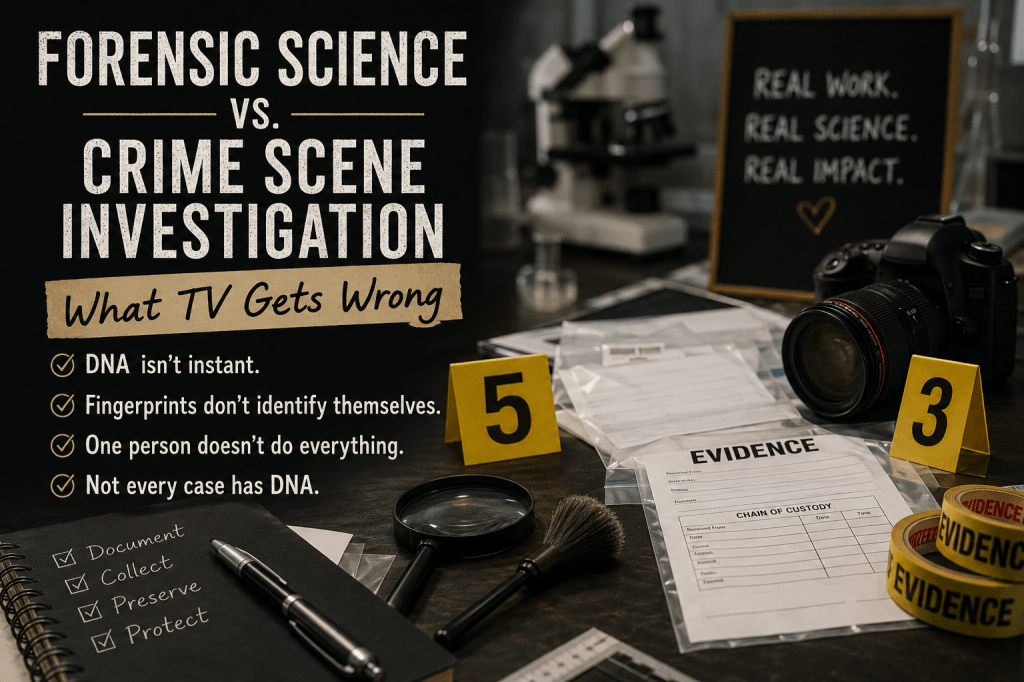
We’ve all watched crime shows like CSI, NCIS, Bones, Law & Order, Criminal Minds, or even Perry Mason.
They’re great shows. Some even pull inspiration from real cases or current events.
But at the end of the day…
They’re entertainment.
A detective doesn’t walk into a room, spend 30 seconds looking around, and magically solve the entire case. DNA doesn’t appear before the next commercial break. The suspect doesn’t always confess within an hour.
There is actually a term for this misunderstanding: the CSI Effect.
It’s when people start expecting real investigations—and even real courtrooms—to work like television. Jurors sometimes expect every case to have DNA, fingerprints, surveillance footage, or some dramatic “gotcha” moment because that’s what they’ve always seen on TV.
Real life is a little different.
Crime Scene Investigation (CSI)
One of the biggest misconceptions is that Forensic Science and Crime Scene Investigation are the same thing.
They’re not.
They’re closely connected, but they’re two very different careers.
Crime Scene Investigators are often considered the last responders to a crime scene. Once the scene is safe and detectives have done their initial work, the CSI is called in to document and collect evidence.
That means they:
- Photograph the scene.
- Sketch and document everything.
- Process for potential fingerprints or other evidence.
- Identify and collect evidence.
- Package it correctly.
- Label everything.
- Maintain the chain of custody from the very beginning.
Their goal isn’t to prove someone is guilty.
Their goal is to preserve the scene and let the evidence speak for itself—without contamination.
Once a scene is released, there’s no “reset” button.
Where Property & Evidence Comes In
This is the part TV almost never shows.
Once evidence leaves the scene, someone has to be responsible for it.
That’s where Property & Evidence comes in.
Property and Evidence Technicians take custody of the evidence, maintain the chain of custody, transport items to the crime lab when testing is needed, securely store evidence, process releases, prepare evidence for court, and oversee final dispositions when a case is complete.
We’re basically the guardians of the evidence.
Depending on the agency, Crime Scene and Property & Evidence may be separate positions—or one person may wear both hats.
Either way, protecting the integrity of the evidence never stops.
Forensic Science
Forensic scientists begin their work once the evidence reaches the laboratory.
Depending on their specialty, they may examine:
- DNA
- Latent fingerprints
- Firearms and toolmarks
- Bloodstain evidence
- Trace evidence
- Toxicology
- Digital evidence
- And many other types of physical evidence.
Here’s another thing TV gets wrong…
Most forensic scientists don’t specialize in everything.
Someone working DNA probably isn’t also examining firearms, fingerprints, toxicology, and digital evidence. These disciplines require years of education, training, and continuing proficiency.
Their job is to perform scientific testing, document their findings, and provide objective conclusions based on the evidence.
And yes—they may also testify in court about the work they personally performed.
Fun fact: In many situations, the analyst who actually performed the testing is the one who has to testify about those results.
So…What Does TV Get Wrong?
Quite a bit.
DNA isn’t instant.
Testing can take days, weeks, or even months depending on the type of evidence, the laboratory’s workload, and the complexity of the case. Some cases require multiple labs which takes even more time.
Fingerprints don’t magically identify people.
They’re compared by trained latent print examiners—not a computer that instantly flashes someone’s driver’s license photo on the screen.
One person doesn’t do everything.
TV loves showing one investigator collecting evidence, interviewing witnesses, interrogating suspects, processing fingerprints, analyzing DNA, and making the arrest.
That almost never happens.
Investigations involve detectives, patrol officers, crime scene investigators, forensic scientists, property and evidence professionals, prosecutors, medical examiners, and many others.
It’s a team effort.
Not every case has DNA.
Sometimes there isn’t biological evidence to collect.
Sometimes fingerprints aren’t left behind.
Sometimes the most important piece of evidence is good documentation.
Final Thoughts
I still love watching crime shows.
I just watch them a little differently now.
They’re fun. They’re exciting. And sometimes they even get parts of the science right.
But the real work isn’t flashy.
It’s slow. It’s methodical. It’s documentation, chain of custody, quality assurance, and making sure every piece of evidence is handled the right way.
Because in real life, that’s what helps the evidence tell its story.


Leave a Reply