By Shyanne Gines
There are professions where getting something wrong is inconvenient.
And then there are professions where getting something wrong can affect an investigation, a criminal case, a victim, a family, or someone’s ability to trust the system meant to help them.
Criminal justice is one of those fields.
Whether you work in law enforcement, victim services, property and evidence, crime scene investigation, forensics, prosecution, corrections, dispatch, or another part of the system, eventually you accumulate experience.
You learn your job.
You recognize patterns.
You develop instincts.
You become faster at making decisions that once required stopping to think through every step.
Experience matters. There is no training course that can completely replicate what years of doing the work will teach you.
But experience creates a danger of its own:
We can start believing that because we know our job, we know enough.
We don’t.
And in a profession that routinely intersects with some of the worst days of other people’s lives, continuing to learn isn’t just about professional development.
It’s part of the responsibility.
Experience Doesn’t Mean Knowing Everything
There is enormous value in institutional knowledge.
The person who has been doing a job for fifteen years often knows things that never made it into a policy manual. They have seen unusual circumstances, learned how systems actually function and watched well-intentioned ideas succeed or fail in practice.
That experience should be respected.
It should not, however, become a substitute for learning.
Sometimes experience teaches us what usually works. Training asks us whether there might now be a better way.
Those aren’t competing ideas.
They need each other.
One of the most valuable things we can bring into professional development is the willingness to consider that something we have done for years might need to change.
Not because we were incompetent before.
Because our profession knows more now than it did then.
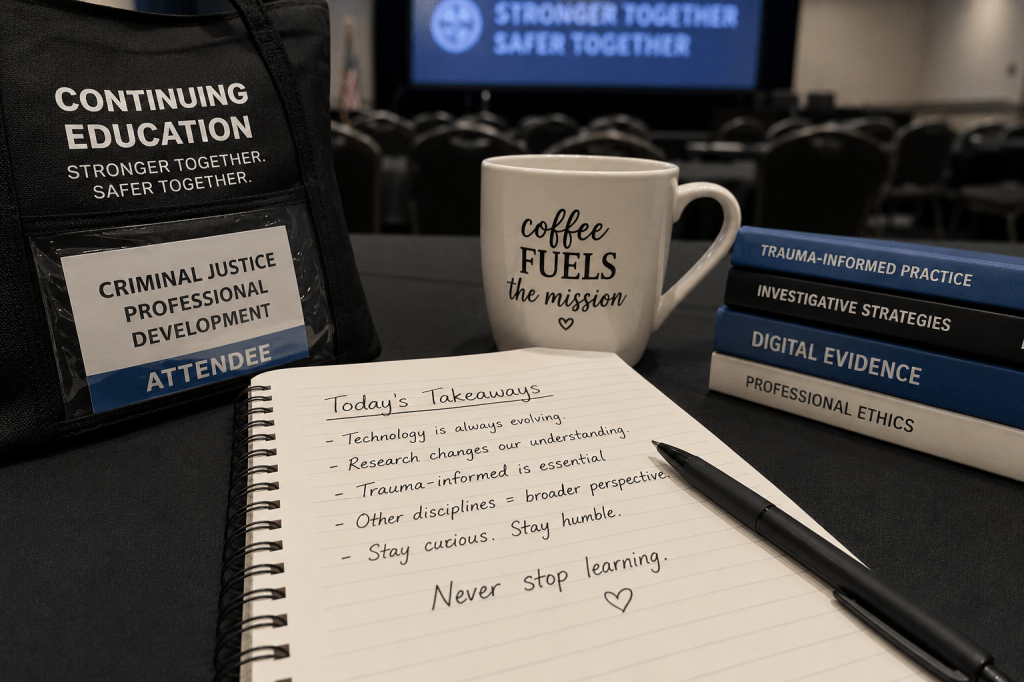
Technology Doesn’t Wait for Us
Think about how dramatically technology has changed criminal justice.
Phones aren’t simply phones anymore. They’re cameras, location devices, communication archives, financial tools and repositories for enormous amounts of personal information.
Social media has changed how people communicate, threaten, harass, document and report behavior.
Digital evidence has become relevant to investigations that would have involved almost entirely physical evidence not that long ago.
Body-worn cameras have changed documentation.
Artificial intelligence is creating entirely new questions about authenticity, evidence, fraud and digital manipulation.
Technology moves quickly.
Policies, laws, research and professional practices have to continually respond to it.
That means the knowledge we entered our careers with cannot possibly be the same knowledge that carries us through the entirety of them.
Research Changes What We Understand
Technology isn’t the only thing changing.
Research changes too.
Our understanding of trauma is one of the clearest examples.
There was a time when behaviors such as fragmented memories, delayed reporting, inconsistent timelines or unexpected emotional responses could easily be interpreted as indications that someone wasn’t telling the truth.
Today, trauma research gives professionals a much more complicated picture.
People do not all respond to traumatic experiences the same way.
Someone may cry.
Someone else may appear completely calm.
Someone may remember extraordinarily specific details while struggling to place other events in chronological order.
Someone may disclose immediately.
Someone else may wait.
Trauma-informed practice doesn’t mean abandoning critical thinking or assuming every account is accurate.
It means understanding that human behavior following trauma is complicated—and making sure our expectations about how a person “should” behave aren’t quietly influencing how we treat them.
That distinction matters.
Trauma-Informed Practice Is More Than Being Nice
“Trauma-informed” can become one of those phrases professionals hear so often that it begins to lose meaning.
But trauma-informed practice isn’t simply being compassionate.
It’s understanding how trauma can affect memory, communication, decision-making, behavior and a person’s interactions with systems.
It’s recognizing that processes that feel routine to us may be happening during one of the most overwhelming moments of someone else’s life.
For a professional, this might be another interview, another evidence submission, another report or another case.
For the person on the other side of that process, it might be the first time they have ever had to navigate any of it.
Training helps us remember that difference.
Criminal Justice Is a System of Intersections
One of the easiest professional blind spots is believing our piece of the system is the piece that matters most.
It isn’t.
An investigator may understand the investigative decisions behind a case but not know everything that happens to evidence after it enters a property room.
A property and evidence professional may understand chain of custody, storage requirements and disposition challenges while never seeing the original scene.
A victim advocate may recognize barriers affecting a victim’s ability to participate that other professionals never encounter.
A forensic examiner may understand the limitations of testing that someone requesting the examination doesn’t fully appreciate.
A prosecutor may see evidentiary or legal problems that weren’t apparent earlier in the process.
Dispatchers may hear details nobody else hears in quite the same way.
Corrections professionals encounter another part of the system entirely.
No single discipline sees the whole picture.
That is exactly why interdisciplinary training matters.
Sometimes the most valuable thing you learn at a conference isn’t from a session specifically designed for your job.
It’s learning how someone else’s job works.
Because suddenly you understand why they ask for something you’ve always found annoying.
Or why a particular piece of documentation matters.
Or why a victim may respond differently after interacting with another part of the system.
Or why something that seems insignificant from your desk becomes extremely important three steps later.
Understanding each other’s roles makes the entire system stronger.
We All Develop Professional Blind Spots
Experience gives us expertise.
It also gives us habits.
The longer we work within a system, the easier it becomes to stop noticing certain things.
We know the terminology.
We know the forms.
We know which hallway to walk down, which phone number to call and what happens next.
The people interacting with our systems often don’t.
Professional blind spots can also develop around procedures.
Sometimes the answer to “Why do we do it this way?” is rooted in law, safety, accreditation or hard-earned lessons.
Sometimes the answer is:
Because we’ve always done it this way.
Those are very different answers.
Training gives us an opportunity to examine which one we’re dealing with.
Continuing Education Creates Space to Question Routine
There is something valuable about temporarily stepping outside your normal workload.
Most professionals aren’t spending an ordinary Tuesday researching the newest studies in their field.
They’re working.
There are reports waiting.
Emails accumulating.
Cases moving.
Evidence arriving.
People needing answers.
Phones ringing.
The day-to-day responsibilities of doing the job don’t always leave much room for studying how the job itself is changing.
Continuing education creates that room.
A good training course gives you the opportunity to hear new research, learn from other professionals, examine emerging problems and compare your organization’s practices with what is happening elsewhere.
Sometimes you leave with a completely new idea.
Sometimes you leave knowing your organization is already doing something well.
And sometimes you leave uncomfortable because you realize something needs to change.
All three can be valuable.
Professional Humility Is a Skill
There is a particular kind of confidence that comes from experience.
There is also a particular kind of confidence that comes from being willing to say:
“I don’t know.”
“I hadn’t considered that.”
“That’s different from what I was taught.”
“I need to learn more about this.”
Those sentences don’t diminish professional credibility.
Used appropriately, they strengthen it.
Criminal justice professionals routinely work with complicated situations involving human behavior, technology, law, trauma, evidence and systems that are constantly evolving.
Nobody masters all of that.
Professional humility means recognizing the limits of your own expertise while remaining committed to expanding it.
It means listening when someone from another discipline understands a piece of the puzzle better than you do.
It means being willing to update your opinion when better information becomes available.
And sometimes it means discovering that something you were absolutely certain about five years ago isn’t something you believe anymore.
That’s not failure.
That’s learning.
The Certificate Isn’t Really the Point
Professional training usually comes with tangible evidence that you attended.
A certificate.
Continuing education hours.
A credential.
Another line for a résumé.
Those things have their place.
But they aren’t really the point.
The point is what happens when you return to work.
Do you ask a different question?
Do you document something more clearly?
Do you understand a victim’s behavior differently?
Do you recognize an emerging form of digital evidence?
Do you handle an item differently?
Do you understand why another discipline needs something from you?
Do you notice a professional blind spot you hadn’t noticed before?
Do you bring information back to someone who couldn’t attend?
Do you change anything?
Because a certificate can prove that you sat in a room.
It cannot prove that you learned.
When the Subject Matter Is Heavy
Some criminal-justice training is technical.
Some of it is procedural.
And some of it is emotionally difficult.
There are professional-development weeks where the subjects being discussed represent real violence, real exploitation, real loss and real people whose lives were permanently changed.
Those weeks feel different from ordinary training.
But perhaps that weight is also a reminder of why the learning matters.
Behind our policies, evidence, reports, statistics, case numbers and continuing-education requirements are people.
People who may encounter us on one of the worst days of their lives.
We owe them competence.
We owe our coworkers competence.
And we owe ourselves enough humility to recognize that competence isn’t something we achieve once and keep forever.
It requires maintenance.
Refusing to Stop Learning
I don’t think the goal of professional development should be walking into a room hoping to confirm everything we already know.
The better question is:
What don’t I know yet?
Maybe the answer comes from new research.
Maybe it comes from new technology.
Maybe it comes from someone who works in a completely different part of the criminal-justice system.
Maybe it comes from realizing an old assumption needs to be reconsidered.
And maybe it comes from a single sentence in a training session that changes how you approach your work when you return.
Experience matters.
Expertise matters.
Training matters.
But perhaps professional humility matters just as much.
Because when your work touches investigations, victims, families, evidence and people’s lives, there will always be more to understand.
The goal isn’t knowing everything. It’s refusing to stop learning.
– The Gilded Margin
 The Gilded Margin
Leave a comment