By Shyanne Gines
We talk a lot about what kids do online.
We talk about strangers.
We talk about cyberbullying.
We talk about location sharing.
We talk about passwords and privacy settings.
But there’s another digital-safety conversation that deserves a lot more attention:
What are we posting about our kids?
Parents call it sharenting—sharing photos, milestones, stories and information about our children online.
And most of the time, it comes from a completely normal place.
Pride.
Love.
Humor.
Wanting to document childhood.
But here’s the part that makes me look at it differently:
Information doesn’t have to be posted with bad intentions to become useful to someone with bad intentions.
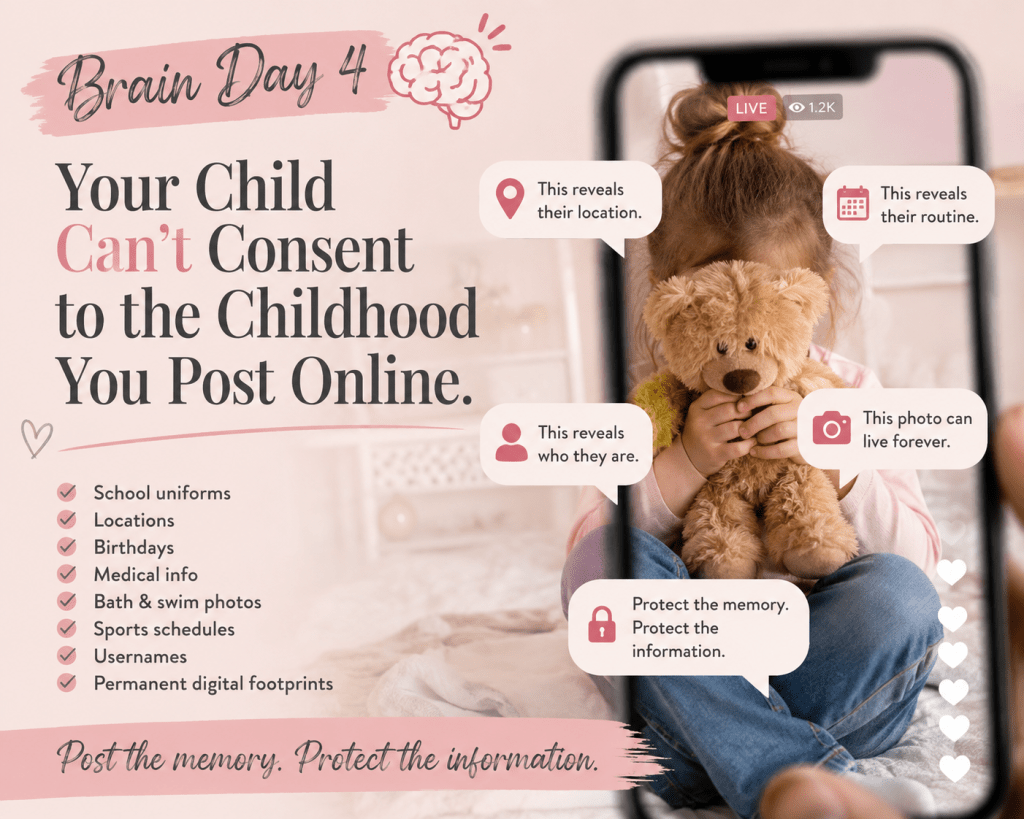
A photo of your child in their school uniform can reveal a school.
A birthday post can reveal their date of birth.
A sports schedule can reveal where they will be—and when.
A photo from the playground can reveal a familiar location.
A proud post about a medical diagnosis can disclose extremely personal health information.
A username can connect accounts.
A family vacation post can announce that nobody is home.
Even an innocent photo can contain identifying details, locations, routines or information that gets copied, saved, shared or used to build a much larger picture.
And then there are the things that seem funny today:
The embarrassing toddler story.
The potty-training story.
The meltdown video.
The bath photo.
The swimsuit picture.
The private family moment that becomes a public punchline.
Your child may eventually be able to laugh about it.
Or they may grow up and wonder why hundreds—or thousands—of people already know something they never chose to tell them.
That’s the part of sharenting I think we need to reconsider.
This isn’t about telling parents they shouldn’t post their children.
It’s about remembering that children are people with privacy, dignity and eventually, a digital identity of their own.
And once something is online, we don’t always get to decide where it goes next.
From a safety perspective, I think the better question isn’t:
“Is this photo cute enough to post?”
It’s:
“What information does this photo give away?”
Before posting, look at the whole picture.
School name.
Uniform.
Street signs.
House numbers.
Team names.
Practice locations.
Birthdays.
Names.
Usernames.
Medical information.
Daily routines.
Then ask yourself:
Would I want my child to have control over this information someday?
Because they don’t get to choose the childhood we’ve already documented for them.
And that doesn’t mean we stop making memories.
It means we start treating childhood privacy like the safety issue it is.
Post the memory. Protect the information.
That feels like a much better digital legacy to leave our kids.
The Gilded Margin Takeaway
Oversharing isn’t always about how much you post.
Sometimes it’s about how much someone can learn from what you’ve posted.
And that’s a very different conversation.
What do you think? Should parents have a different standard for posting about their children than they do for posting about themselves?
-The Gilded Margin


Leave a Reply