Life Monday | Gilded Margin
There is a weird thing about workplace evaluations that I think we need to talk about.
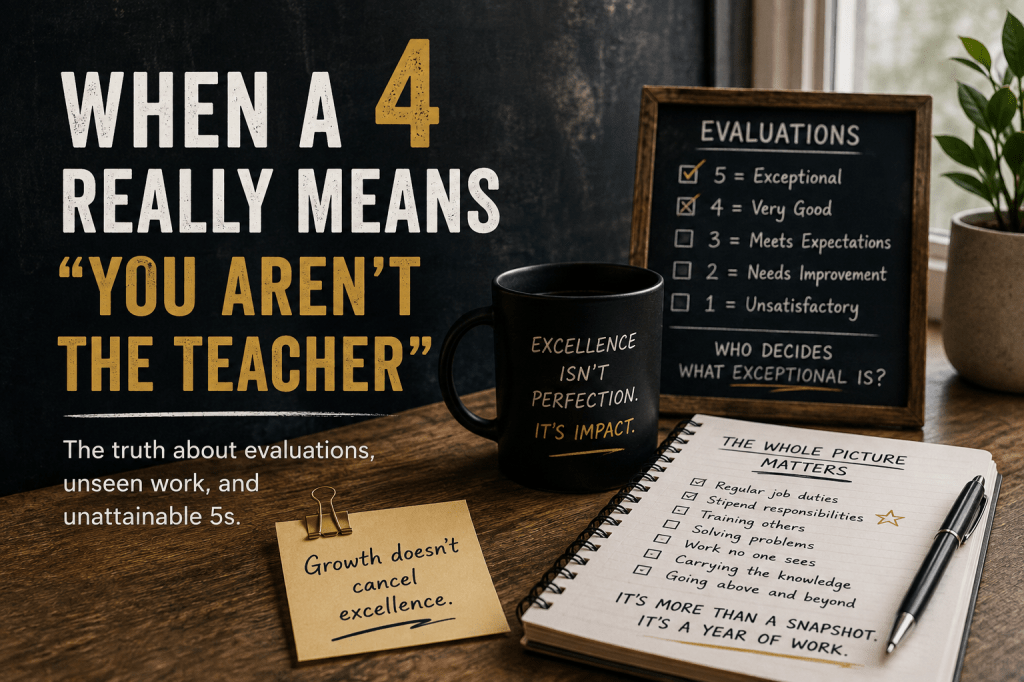
Sometimes a 4 doesn’t really mean you’re a 4.
Sometimes it means:
“You’re doing a really damn good job. Your work is quality. You’re dependable. You know what you’re doing. You take initiative. You contribute. We don’t have much to criticize. But we’re still giving you a 4 because nobody gets a 5.”
And the explanation is usually something along the lines of:
“We can all continue to grow.”
Well… yeah.
Of course we can.
Nobody reaches a point in their career where there is absolutely nothing left to learn.
But here’s where I struggle with that reasoning:
If everyone automatically gets a 4 because everyone has room to grow, what exactly does a 5 mean?
Because if a 5 is actually on the evaluation form, shouldn’t there be a realistic way to earn it?
I Was Actually Given an Explanation
This isn’t completely hypothetical for me.
When I questioned a 4 on my own evaluation, the explanation I was given was essentially:
“When you’re the teacher, you get 5s. When you’re not the teacher, you don’t.”
That statement stuck with me.
Because I understand the concept behind it.
If you’re the person considered the expert or the teacher in a particular area, perhaps you’re viewed as having reached a higher level of mastery.
But here’s the problem:
What does that mean for everyone else?
What does it mean for the employee who is exceptionally good at their job but isn’t the person designated as the teacher?
What does it mean for someone who has spent years developing expertise but doesn’t have a formal teaching role?
What does it mean for someone whose position simply isn’t structured around being “the teacher”?
Are they automatically capped at a 4?
If so, then the rating isn’t really measuring performance.
It’s measuring whether someone occupies a particular role.
And those aren’t necessarily the same thing.
You Can Be Excellent Without Being the Teacher
There is a difference between being a teacher and being exceptionally competent at your job.
A teacher can be excellent.
But not every excellent employee is a teacher.
Some people are researchers.
Some are analysts.
Some are investigators.
Some are technicians.
Some are coordinators.
Some are specialists.
Some are problem-solvers.
Some are the people quietly keeping an entire process running.
Some are experts who don’t have a formal teaching responsibility.
And some people are incredibly good at what they do but simply aren’t the person assigned to teach everyone else.
That shouldn’t automatically make their performance less than exceptional.
Because teaching is a responsibility.
It isn’t necessarily the definition of mastery.
A 5 Shouldn’t Mean “Perfect”
Maybe we’ve confused excellence with perfection.
A 5 shouldn’t necessarily mean:
“This person knows absolutely everything and has nothing left to learn.”
Because that person doesn’t exist.
A 5 can simply mean:
“During this evaluation period, this employee demonstrated exceptional performance in this area.”
That’s it.
You can be exceptional and still have room to grow.
Those two things can exist at the same time.
You can earn a 5 today and still have goals tomorrow.
You can be excellent at your job and still learn something new next week.
You can be highly experienced and still encounter a situation you’ve never seen before.
Continuous growth does not cancel excellence.
Then There’s the “You Aren’t the Teacher” Problem
This becomes even more complicated when the person evaluating you doesn’t really understand the specialized area in which you work.
That doesn’t necessarily mean they’re a bad supervisor.
A person can be a perfectly capable manager without being an expert in every specialized position underneath them.
But supervising someone’s work and understanding their work are two different things.
You can see whether someone shows up.
You can see whether they’re professional.
You can see whether they communicate.
You can see whether deadlines are met.
But do you necessarily understand the technical details of what they’re doing?
Do you know which decisions require experience?
Do you know how much institutional knowledge they’re using?
Do you know when someone prevented a problem that nobody else ever knew was coming?
Do you know the difference between someone simply completing a task and someone doing that task exceptionally well?
Sometimes, you don’t.
And that’s not necessarily anyone’s fault.
It’s just reality.
But then we have to ask:
How accurately can someone evaluate work they don’t fully understand?
The Chief Doesn’t See Everyone Every Day
There’s another reality in organizational life.
The person at the top doesn’t see everything.
The chief isn’t sitting in every office every day.
The chief isn’t watching every employee work.
They’re not necessarily seeing who stays late to finish something correctly.
They’re not necessarily seeing who catches problems before they become bigger problems.
They’re not necessarily seeing who takes ownership without being asked.
They’re not necessarily seeing who quietly carries a huge workload.
They’re not necessarily seeing the quality of someone’s work on an ordinary Tuesday when nobody important is around.
And that’s not necessarily a criticism of the chief.
It’s reality.
Leadership has to depend on supervisors to communicate what is happening within their divisions.
Which means the supervisor’s perspective matters.
A lot.
The chief may ultimately see a collection of numbers.
The supervisor is the person who decided what those numbers meant.
And if supervisors aren’t using the same standards, those numbers aren’t necessarily comparable.
Every Supervisor Evaluates Differently
This is another part of employee evaluations that doesn’t get enough attention.
Every supervisor is different.
One supervisor might think:
“Nobody gets a 5.”
Another might think:
“If you’re exceeding expectations, you get a 5.”
One might believe that a 4 means excellent.
Another might consider a 4 simply above average.
One supervisor may focus heavily on productivity.
Another may focus on personality.
Another may focus on following instructions.
Another may heavily reward initiative.
Another may rarely reward initiative.
Same organization.
Same evaluation form.
Same rating scale.
Different people holding the pen.
Different standards.
Different results.
The Hard Worker Can End Up Looking Like the Worse Employee
This is where evaluations can become particularly unfair.
Imagine two employees.
Employee A works their ass off.
Their work is consistently high quality.
They take ownership.
They solve problems.
They take on additional responsibilities.
They don’t need someone standing over them to make sure things get done.
Their supervisor believes that nobody should receive a 5.
So Employee A gets a 4.
Employee B does less.
Their work isn’t necessarily as consistent.
They don’t take on the same workload.
But their supervisor is more generous with ratings.
Employee B gets a 5.
Now someone higher up looks at the evaluations.
Employee B has a 5.
Employee A has a 4.
On paper, Employee B looks better.
But what if the numbers weren’t generated with the same ruler?
That’s not necessarily an employee performance problem.
That’s an evaluation problem.
The person working harder can actually end up looking like the weaker employee because of the supervisor they happen to have.
And that’s a pretty significant flaw in a system that’s supposed to measure performance.
We Need to Talk About Calibration
Organizations that use performance evaluations should ask whether supervisors are actually calibrated to the same standards.
What does a 3 mean?
What does a 4 mean?
What does a 5 mean?
What specific behaviors, results or competencies qualify someone for each rating?
What evidence supports the rating?
And perhaps most importantly:
Would different supervisors give the same employee the same rating if they were looking at the same evidence?
If the answer is no, then the organization doesn’t really have one evaluation system.
It has several individual evaluation systems operating under the same form.
And employees shouldn’t be penalized because they happened to get the supervisor who believes a 5 is practically unattainable.
Then There Are the Jobs Within the Job
This is another piece that I don’t think gets enough attention.
A lot of employees have responsibilities beyond their basic job description.
Maybe it’s a stipend position.
Maybe it’s a specialty assignment.
Maybe it’s training.
Maybe it’s coordinating something.
Maybe it’s being the person everyone goes to because they know how to do something nobody else knows how to do.
Maybe it’s an additional role that takes hours of work that aren’t necessarily visible to the person’s primary supervisor.
And what happens when the supervisor responsible for that additional role isn’t communicating with the supervisor completing the employee’s evaluation?
That work can disappear.
Not because the employee didn’t do it.
Not because it wasn’t important.
Not because it wasn’t done well.
Simply because the person writing the evaluation didn’t see it.
Stipend Work Shouldn’t Become Invisible Work
This is especially important when an employee has a stipend role.
If the organization has decided that an employee’s additional responsibilities are valuable enough to compensate them for, then those responsibilities are clearly part of the employee’s contribution to the organization.
I’m not saying a stipend role should automatically increase someone’s evaluation score.
That’s not the point.
The point is that the work should at least be seen and considered.
If another supervisor oversees that role, there should be communication.
If the employee is performing additional responsibilities, there should be a mechanism for those responsibilities to be reflected.
Otherwise, the employee is being evaluated on only part of what they actually do.
That’s the Problem With a Snapshot
An evaluation is a snapshot.
But an employee isn’t a snapshot.
A person can have their regular job and additional responsibilities.
They can train people.
They can solve problems.
They can take on projects.
They can work behind the scenes.
They can be the person other employees rely on.
They can do an enormous amount of work that isn’t necessarily visible from the perspective of the person completing their annual evaluation.
And then once a year, all of that gets condensed into a handful of numbers.
That’s a pretty small window through which to judge an entire year of someone’s work.
The Evaluation Isn’t Showing the Entire Person
An employee is more than the portion of their job that one supervisor happens to see.
They’re more than their job title.
They’re more than their evaluation form.
They’re more than a handful of numbers.
They may have responsibilities under multiple supervisors.
They may have specialty assignments.
They may train others.
They may solve problems nobody else sees.
They may be carrying institutional knowledge that isn’t written anywhere.
They may be the person other employees depend on.
And yet all of that can be reduced to:
4.
That’s not necessarily a complete evaluation.
It’s a snapshot.
And a snapshot can be useful.
But a snapshot isn’t the whole picture.
Lack of Communication Becomes an Evaluation Problem
This is why communication isn’t just an operational issue.
It can become an evaluation issue.
If supervisors aren’t communicating with each other, how can leadership accurately evaluate an employee who works across multiple areas?
If someone has additional responsibilities, who is responsible for making sure that work is considered?
If an employee spends significant time performing a stipend assignment, does the person evaluating them know what that work involves?
Has anyone asked the supervisor responsible for that role how the employee is performing?
Has the employee been given an opportunity to explain the additional responsibilities they’re carrying?
Or does the annual evaluation simply reflect whichever portion of their job the evaluator happens to know best?
Those are important questions.
Visibility Isn’t Performance
This may be my biggest problem with the whole thing.
Visibility isn’t the same thing as performance.
The employee who is constantly visible isn’t necessarily working harder.
The employee who has a quiet office isn’t necessarily doing less.
The employee who receives a 5 isn’t automatically better than the employee who receives a 4.
The employee who gets praised more isn’t automatically contributing more.
And the employee whose supervisor doesn’t know about their additional responsibilities shouldn’t automatically receive less recognition for them.
Sometimes the person doing the most isn’t the person who is most visible.
Sometimes they’re the person quietly getting things done.
What Does an Unattainable 5 Do to Employees?
This is where the issue goes beyond hurt feelings.
If employees believe the highest rating is unattainable, it can eventually change their mindset.
At first, they might think:
“Okay. I got a 4. What do I need to do to get a 5 next time?”
That’s a healthy response.
But if the answer is:
“Nothing. Nobody gets a 5 unless they’re the teacher.”
Eventually the question can become:
“Then why am I trying so hard?”
That’s a very different mindset.
Why take on the difficult assignment?
Why volunteer?
Why stay late?
Why learn something new?
Why take on additional responsibilities?
Why consistently produce exceptional work?
Why become the person everyone depends on?
If the result is always the same, some employees will eventually stop believing that additional effort changes the outcome.
It Can Turn “Keep Growing” Into “Why Bother?”
There’s a huge difference between:
“Here’s what you can improve to reach the next level.”
and:
“You can always improve, so you’re getting a 4.”
The first gives an employee a path.
The second gives them a wall.
If there are specific things an employee can work on to move from a 4 to a 5, that’s useful.
Maybe they need additional training.
Maybe they need to develop leadership skills.
Maybe they need to demonstrate greater initiative.
Maybe they need to take on more complex responsibilities.
Maybe they need to improve a specific competency.
Great.
Now they know what to do.
But if the 5 is reserved for a role the employee doesn’t occupy, there isn’t really anything they can do about it.
That’s not a growth opportunity.
That’s a ceiling.
And ceilings can be demoralizing.
It Can Make Employees Stop Trusting the Evaluation
Eventually, employees notice patterns.
They compare supervisors.
They compare ratings.
They compare workloads.
They compare recognition.
They compare opportunities.
And if they repeatedly see that different supervisors use completely different standards, the evaluation system starts losing credibility.
Employees may stop thinking:
“How am I performing?”
and start thinking:
“How does my supervisor rate people?”
That’s a huge difference.
One is about professional development.
The other is about managing the evaluator.
It Can Create a “Why Bother?” Culture
People pay attention to incentives.
If the organization recognizes exceptional work, employees have a reason to pursue exceptional work.
If the organization recognizes initiative, employees have a reason to take initiative.
If additional responsibility is recognized, employees may be more willing to accept it.
But if employees learn that doing more doesn’t meaningfully change how they’re evaluated, some will eventually adjust their effort accordingly.
They may stop volunteering.
Stop taking on additional projects.
Stop staying late.
Stop being the person who always fixes things.
Stop trying to prove themselves.
Not because they suddenly don’t care.
Because they learned the system.
And the system taught them:
Do enough to get the 4.
That’s not the culture most organizations say they want.
And Then I Have Another Question
Where is the evaluation of the manager?
Seriously.
Employees are evaluated on:
Performance.
Communication.
Leadership.
Teamwork.
Accountability.
Professionalism.
Productivity.
Problem-solving.
Adaptability.
Initiative.
Quality.
We’re expected to receive feedback on how we’re performing.
But how does the employee provide meaningful feedback about the person managing them?
Where do employees get to say:
My supervisor communicates well.
My supervisor doesn’t communicate well.
My supervisor recognizes good work.
My supervisor doesn’t.
My supervisor applies standards consistently.
My supervisor doesn’t.
My supervisor understands the work.
My supervisor doesn’t.
My supervisor helps me develop.
My supervisor makes my job unnecessarily difficult.
That’s not about creating a workplace popularity contest.
It’s about accountability.
Because if feedback is valuable enough to evaluate employees, why wouldn’t feedback be valuable enough to evaluate management?
Accountability Can’t Only Flow Downhill
This is where workplace culture gets interesting.
Employees are told:
“You have room to grow.”
Fair enough.
But supervisors have room to grow too.
Managers have room to grow.
Chiefs have room to grow.
Everyone does.
If we’re going to use continuous improvement as a reason to hold employees back from the highest rating, then that philosophy should apply to everyone.
Because accountability shouldn’t only travel in one direction.
It should go both ways.
What Should an Evaluation Actually Do?
I don’t think evaluations should just be about numbers.
They should answer some basic questions:
- What did this person accomplish?
- How well did they perform their actual responsibilities?
- What additional responsibilities did they take on?
- What did they do exceptionally well?
- Where can they improve?
- What support do they need?
- What does the next level of growth look like?
And if someone gets a 4 instead of a 5, there should be an actual reason.
Not just:
“Because nobody gets a 5.”
And not just:
“Because we can all improve.”
Tell me what I need to improve.
Tell me what exceptional looks like.
Tell me what separates a 4 from a 5.
Give me something I can actually work toward.
Because Maybe the Problem Isn’t the Employee
Sometimes we’re very quick to look at an evaluation score and assume the number tells the whole story.
It doesn’t.
The score may reflect the employee.
It may reflect the supervisor.
It may reflect the supervisor’s philosophy.
It may reflect how much the supervisor actually sees.
It may reflect how well supervisors communicate with one another.
It may reflect whether additional responsibilities were considered.
It may reflect how conservative or generous someone is with ratings.
And sometimes it may reflect all of those things at once.
That’s why I don’t think we should automatically treat an evaluation score as objective truth.
A number is only as good as the process that produced it.
I Don’t Need a Perfect Score
And just to be clear, this isn’t about needing a 5.
A 4 is a good score.
I’m not saying everyone should get a 5.
They shouldn’t.
I’m saying a 5 shouldn’t be treated like a mythical creature that exists on the evaluation form but is never actually allowed to appear.
If I’m doing something exceptionally well, tell me.
If I’m not, tell me.
If there is something I need to improve, give me something specific.
If my supervisor doesn’t understand my specialty, find a way to make sure my expertise is fairly evaluated.
If I have responsibilities under another supervisor, communicate.
If managers are evaluating employees, create meaningful opportunities to evaluate managers too.
And if a 5 is actually achievable, explain what it takes to earn one.
The Whole Picture Matters
At the end of the day, an employee is more than their evaluation.
They’re more than a number.
They’re more than the opinion of one supervisor.
They’re more than the portion of their work that happens to be visible.
And they’re certainly more than whether someone believes a 5 should be allowed.
A fair evaluation should try to capture the whole picture.
The good.
The bad.
The accomplishments.
The mistakes.
The growth.
The additional responsibilities.
The work nobody saw.
The work another supervisor saw.
The skills the employee has mastered.
And the things they still need to learn.
Because yes…
I still have things to learn.
So does everybody else.
That doesn’t mean I haven’t already learned enough to be damn good at what I do.
And maybe that’s the part we’ve gotten wrong.
Growth doesn’t cancel excellence.
The Gilded Margin Takeaway
Maybe we don’t need fewer 5s.
Maybe we need better definitions of what the numbers mean.
Maybe we need supervisors who are calibrated to the same standards.
Maybe we need communication between managers when an employee’s work crosses departments or includes stipend responsibilities.
Maybe we need evaluations that recognize the work happening outside the evaluator’s immediate line of sight.
Maybe we need a way for employees to provide meaningful feedback about the people evaluating them.
And maybe we need to stop treating “there is always room to grow” as though it automatically means someone hasn’t earned the highest rating.
Because the person evaluating you can have room to grow too.
The supervisor can have room to grow.
The chief can have room to grow.
Everyone can have room to grow and still be excellent at what they do.
That’s not contradictory.
And maybe that’s the point.
A 5 shouldn’t mean you’re finished learning.
It should mean that, based on the expectations of your position and the work you’ve actually performed, you excelled.
Because telling employees they have room to grow can be motivating.
Telling them they have room to grow while simultaneously making the highest level unattainable sends a very different message.
One says:
“Keep going.”
The other eventually says:
“Why bother?”
And organizations should be very careful about which message their evaluation system is actually sending.
Because employees don’t need to be told they’re perfect.
They need to know that excellent work can actually be recognized as excellent work.
And if the number on the form doesn’t reflect the whole picture, then maybe the problem isn’t the employee.
Maybe the picture is incomplete.
-The Gilded Margin


Leave a Reply