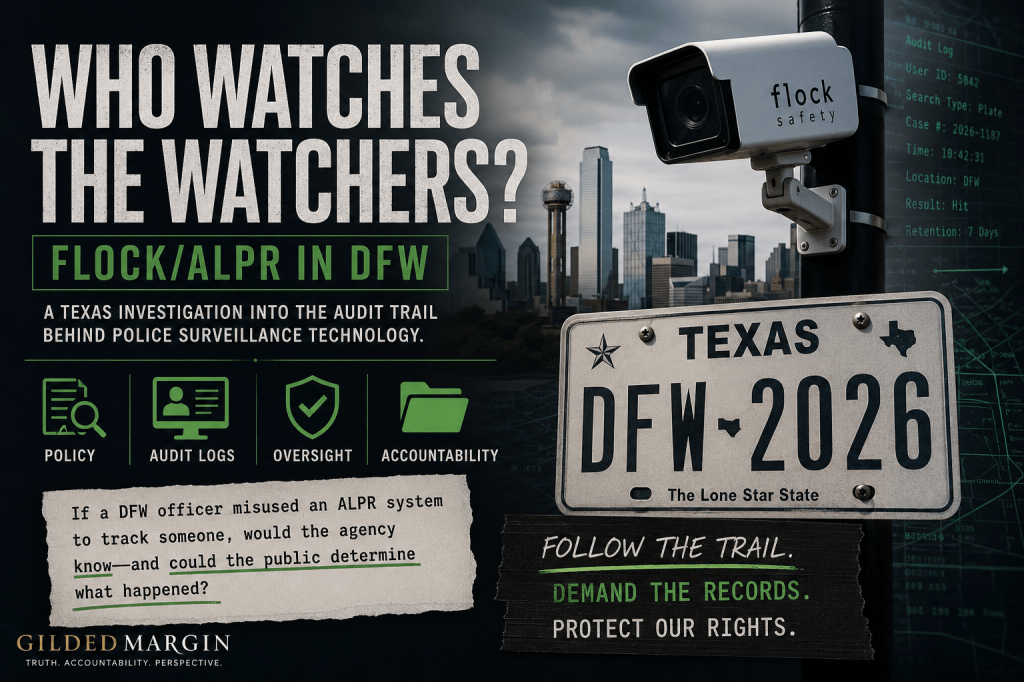
Flock/ALPR in DFW — and the audit trail behind police surveillance
Deep Dive| Gilded Margin
There is a point where a conversation about surveillance technology has to move beyond “Are Flock cameras good or bad?”
That point is accountability.
Flock Safety has announced significant changes to its law-enforcement safeguards following months of scrutiny over alleged misuse of its automated license-plate-reader system. The changes include mandatory auditing tools, required case codes for searches, controls intended to restrict inappropriate data sharing, and a reduction in default license-plate data retention from 30 days to seven days. Agencies can still extend retention for particular investigations. (The Guardian)
And this is not happening in a vacuum.
The Harris County Sheriff’s Office has suspended three deputies’ access to Flock cameras while investigating potential misuse. The agency has also announced additional auditing requirements. At this point, those allegations remain under investigation, which matters. An allegation is not a finding. (Houston Chronicle)
That distinction should remain at the center of this conversation.
Because the most interesting question for North Texas is not whether an officer somewhere else allegedly misused an ALPR system.
It is this:
- If a DFW officer misused an ALPR system to track someone, would the agency know?
And perhaps more importantly:
- Could the public determine what happened?
That is an entirely different investigative question.
The technology is changing. The oversight needs to be tested.
Flock says it is strengthening the safeguards surrounding its system.
Its current tools include required offense-type information for searches, search-reason and case-number fields, audit records, search filters, and public transparency tools. Flock says those tools are intended to make system use visible and reviewable. (Flock Safety)
But a safeguard existing inside a technology platform is not the same thing as an effective oversight program.
The real test happens at the agency level.
Does the department have a policy?
Does the policy match the contract?
Does the configuration match the policy?
Are searches actually reviewed?
Are suspicious searches flagged?
Are case numbers required?
How long are the records retained?
Who has administrative access?
What happens when an employee violates policy?
And what portion of that process can the public actually see?
That is where the DFW story gets interesting.
The investigation I would want to see
- Dallas.
- Fort Worth.
- Arlington.
- Plano.
- Frisco.
- Denton.
- And the counties operating or participating in ALPR networks.
Pull the records.
Not because we should assume misconduct.
Because accountability requires records capable of proving whether misconduct occurred.
I would want to examine:
- Current ALPR/Flock policies
- Historical versions of those policies
- Contracts, renewals, amendments and exhibits
- Data-sharing agreements
- Retention settings and retention schedules
- Audit-log retention
- Aggregate searches by month
- Searches without case numbers, where that information is maintained
- Internal audits and compliance reviews
- Misuse investigations
- Disciplinary outcomes, appropriately de-identified where necessary
- User-access and administrative controls
- Policies governing searches connected to stalking, domestic violence, missing persons and protective orders
And I would compare the documents.
Because sometimes the most important story isn’t in one record.
It is in the gap between what the policy says, what the contract says, what the software allows and what actually happens.
There is another reason this deserves attention
ALPR technology can be incredibly useful.
It can help locate stolen vehicles.
It can provide investigative leads.
It can assist in locating missing people.
It can help investigators reconstruct movements surrounding a crime.
Those are legitimate public-safety uses.
But usefulness does not eliminate the need for controls.
In fact, the more useful a technology becomes, the more important the controls become.
A system capable of answering “Where was this vehicle?” can be an extraordinary investigative tool.
It can also become extraordinarily invasive if someone uses it for a purpose they were never authorized to pursue.
That is why I don’t think the responsible question is simply “Should police have ALPR?”
The better question is:
What prevents an authorized user from using an authorized system for an unauthorized purpose?
And then:
What record is created when that happens?
The Texas test
Texas now has a very interesting opportunity to examine this question in real-world conditions.
Flock has changed its safeguards.
Texas agencies have experienced documented scrutiny over ALPR use, including the current Harris County investigation and a reported Deer Park disciplinary case following an internal audit that found misuse. (Houston Chronicle)
That means the conversation can move away from hypothetical scenarios.
We can ask agencies to show us how their systems are actually governed.
Not “Trust us.”
Not “The technology has safeguards.”
Show us the policy.
Show us the audit structure.
Show us the retention rules.
Show us how searches are reviewed.
Show us what happens when someone violates the rules.
And, where public records law permits it, show the public the resulting accountability trail.
Who watches the watchers?
That is the Gilded Margin question.
Because the camera isn’t the only thing that matters.
The person behind the keyboard matters.
The supervisor matters.
The policy matters.
The audit log matters.
The contract matters.
The retention period matters.
The records custodian matters.
And the public’s ability to ask questions matters.
I don’t want this investigation to begin with the assumption that DFW law enforcement agencies are abusing ALPR technology.
I want it to begin with something much more uncomfortable:
Can we prove that they aren’t?
And if misuse does occur, can the system detect it, can the agency respond to it, and can the public eventually know what happened?
That is not an anti-police question.
It is not a pro-surveillance question.
It is an accountability question.
And in a system designed to document where vehicles go, perhaps the first trail we should follow is the trail documenting who searched for them, why they searched, and who was watching.
Sources
Flock Safety. (2026). Offense type dropdown: A simpler, more accurate audit.
Flock Safety. (2026). How Flock builds transparency into public safety technology.
Flock Safety. (2026). Search safeguards: How Flock’s search filters work.
The Guardian. (2026, August 13). Flock Safety tries to curb police abuse of its surveillance cameras after scandals.
Houston Chronicle. (2026, August 15). Harris County Sheriff’s Office blocks 3 deputies’ Flock camera access during investigation.
Houston Chronicle. (2026, August 15). Deer Park police officer disciplined after audit finds misuse of Flock license plate cameras.


Leave a Reply