Brain Tuesday| Gilded Margin
August 12, 2026
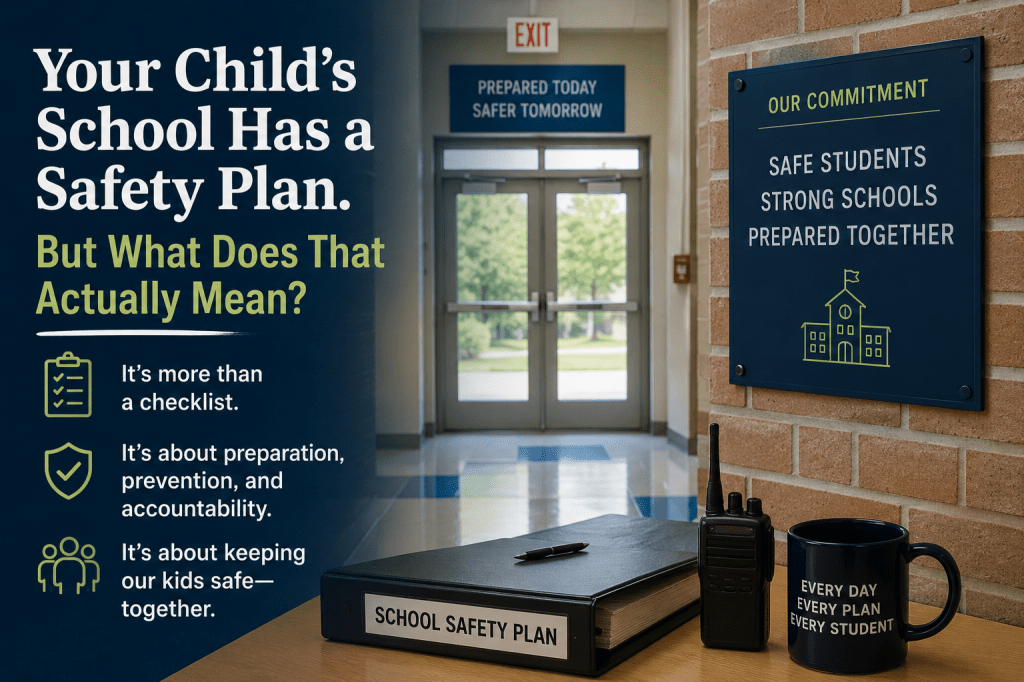
There is a particular kind of sentence that makes parents feel both reassured and uneasy at the same time:
“The school has a safety plan.”
Okay. Good.
But what does that actually mean?
Because “we have a safety plan” can sound like a folder sitting in an administrator’s office. It can sound like a lockdown drill, a list of emergency phone numbers, or a mass email telling parents where to find information if something happens.
In reality, school safety in Texas is much bigger than any one plan.
And right now, Texas schools are entering an important implementation and reporting window.
For independent school districts, the current three-year safety and security audit cycle ends August 31, 2026. Districts then have through September 15 to submit their three-year audit survey results to the Texas School Safety Center (TxSSC, 2026). At the same time, the Texas Education Agency (TEA) has proposed new and updated rules concerning school-safety requirements and consequences for systems that fail to comply, including a proposed rule allowing the commissioner to assign a conservator for certain school-safety noncompliance beginning September 1, 2026 (TEA, 2026).
That may sound like government paperwork.
For parents, it really isn’t.
It is about what happens before, during and after somebody says, “Something doesn’t feel right.”
School safety is not just about the doors and cameras
When people hear “school safety,” the first things that often come to mind are locked doors, cameras, school resource officers, metal detectors, alarms and lockdown drills.
Those things matter.
But Texas’ school-safety framework also includes behavioral threat assessment, emergency planning, physical security assessments, communication procedures, mental-health considerations, law enforcement coordination and ongoing improvement.
The Texas School Safety Center describes the safety and security audit as a process for evaluating a district’s safety measures, security protocols and emergency preparedness. The center also emphasizes that safety should not be treated as something a district checks off once every three years. Safety assessments, training, planning and improvements should be ongoing (TxSSC, 2026).
That distinction matters.
A school can technically have a safety plan and still have areas that need improvement.
A safety audit is designed to help identify those areas.
Think of it less like a report card that says safe or unsafe and more like someone walking through the system asking uncomfortable but necessary questions:
Does this door actually lock?
Can people get into this building when they shouldn’t?
Can staff communicate during an emergency?
Can first responders get the information they need?
Are emergency procedures accessible to students and staff with different needs?
What happens if the normal communication system fails?
What happens after the immediate emergency is over?
Those are very different questions from simply asking whether a school has a safety plan.
Then there is threat assessment
This is one of the most important pieces parents may not know exists.
Texas requires public school districts and open-enrollment charter schools to have Safe and Supportive School Program teams that conduct behavioral threat assessments. These teams are intended to look at concerning behavior, gather information, assess whether someone actually poses a threat and determine appropriate interventions (TxSSC, 2026).
And this is important:
Threat assessment is not the same thing as punishment.
The goal isn’t simply to find a student who made a threatening statement and immediately label that student dangerous.
The process is intended to determine the difference between making a threat and posing a threat.
That means looking at the circumstances and the available information.
A multidisciplinary team may include people with expertise in areas such as counseling, behavior management, mental health, education, school administration, safety, emergency management and law enforcement. The purpose of bringing different perspectives together is to understand the situation instead of making a decision based on one piece of information (TxSSC, 2026).
That’s a very different approach from the image many of us have in our heads when we hear the words “threat assessment.”
And parents aren’t supposed to be completely in the dark
This is one area where Texas parents have specific rights.
If a school behavioral threat assessment is going to be conducted on your child, the threat assessment team must notify you of its intent before conducting the assessment, subject to the requirements surrounding an immediate emergency. Parents must also be given an opportunity to participate by providing information about their child, either in person or remotely (TxSSC, 2026).
That does not mean a parent becomes a member of the threat assessment team or gets to sit in on every part of the process.
There are privacy and confidentiality requirements involving other students and school personnel.
But after the assessment is completed, the team is required to provide the parent or guardian with its findings and conclusions regarding the student.
That’s a much more concrete answer to the question, “What does the school actually do when there is a concern about my child?”
So who handles a threat?
The answer isn’t always “the police.”
And it isn’t always “the principal.”
School safety is designed to involve multiple people depending on the circumstances.
A behavioral concern may go to the school’s Safe and Supportive School Program or threat assessment team. A physical security problem may involve the district’s safety and security personnel. An emergency may require school administrators, emergency management, law enforcement, fire/EMS or other responders.
Sometimes those roles overlap.
That’s intentional.
A school shouldn’t have to invent a response in the middle of a crisis. The people responsible for different pieces of the response should already know what their roles are.
That is what preparedness is supposed to accomplish.
What about the actual safety audit?
Texas Education Code requires school districts to conduct safety and security audits at least once every three years.
The current independent school district cycle began September 1, 2023, and ends August 31, 2026. The reporting window for those audit results runs through September 15, 2026 (TxSSC, 2026).
The audit process looks at safety and security from a broader perspective than parents may realize. The TxSSC toolkit includes tools for reviewing written safety and security documentation, planning the audit, identifying vulnerabilities and developing improvement plans.
And here’s something parents should understand:
Not every detail of a school security assessment is going to be public.
There is a legitimate difference between transparency and handing out a blueprint of a school’s vulnerabilities.
For example, parents have a reasonable interest in knowing that a school has emergency procedures, conducts required drills, maintains communication systems and has processes for responding to threats.
That does not necessarily mean parents should receive a detailed map showing every camera, access-control weakness, security vulnerability or law-enforcement response tactic.
Good safety planning has to balance both.
Parents deserve meaningful information without schools being required to publish information that could make a building less secure.
What should parents actually ask?
This is where I think the conversation gets much more useful.
Instead of asking only, “Is the school safe?” — which is almost impossible to answer honestly with a yes or no — ask questions that tell you how the system works.
You could ask:
- “How are parents notified during a significant emergency?”
- “What is the school’s process for reporting concerning behavior?”
- “Who is responsible for behavioral threat assessments?”
- “How does the school involve parents when their child is the subject of a threat assessment?”
- “What emergency drills are conducted during the school year?”
- “How does the school accommodate students with disabilities or other access and functional needs during emergencies?”
- “How does the school coordinate with local law enforcement and first responders?”
- “How often are safety procedures reviewed?”
- “Where can I find the district’s parent-facing emergency information?”
And perhaps my favorite:
“If my child sees something concerning, who exactly should they tell?”
Because a safety plan isn’t very useful if a child doesn’t know how to use it.
Preparedness shouldn’t mean raising terrified kids
This may be the hardest part for parents.
We want our children to be prepared.
We do not want them to spend their school day imagining every possible catastrophe.
There is a difference.
Teaching a child where to go during an emergency is preparedness.
Teaching a child how to report something that concerns them is preparedness.
Explaining that adults at school have procedures for emergencies is preparedness.
Making a child believe that danger is waiting around every corner is fear.
Those are not the same thing.
School safety should ultimately be about creating an environment where children can learn, teachers can teach and families can trust that problems are being taken seriously before they become emergencies.
That requires more than locked doors.
It requires people who know their roles.
It requires systems that are actually tested.
It requires schools to look honestly at vulnerabilities.
It requires law enforcement and emergency responders to be part of the larger picture.
It requires parents to know how to report concerns.
And it requires schools to communicate with families without compromising the information that needs to remain protected.
This is the part parents should be paying attention to right now
August can feel like the least complicated time to think about school safety.
We’re buying school supplies, searching for missing shoes, filling out forms, trying to remember lunch-account passwords and attempting to get everyone back onto a school-night sleep schedule.
But August 2026 is also the end of an important Texas school-safety audit cycle for independent school districts.
By September 15, districts in the 2023–2026 cycle will be reporting their three-year audit results.
And September 1 is also the proposed effective date for new TEA rules concerning school-safety requirements and consequences for certain noncompliance, including the proposed assignment of a conservator to a school district that fails to meet specified safety obligations (TEA, 2026).
That doesn’t mean parents should panic.
Actually, I think the opposite is true.
This is a good time to ask questions while nothing is happening.
Ask before there is an emergency.
Find out how your child’s school communicates.
Find out how your child reports a concern.
Know who handles behavioral threats.
Understand what information parents receive.
And remember that a safety plan isn’t supposed to exist just because somebody was required to write one.
It is supposed to be something people know how to use.
Because the goal isn’t to raise children who are afraid of school.
The goal is to make sure the adults responsible for them are prepared to protect them — and that parents understand enough about the system to know what “prepared” actually means.
References
Texas Education Agency. (2026). Proposed commissioner of education rules. Texas Education Agency.
Texas Education Agency. (2026). School safety updates. Texas Education Agency.
Texas School Safety Center. (2026). A parent’s guide to school safety toolkit. Texas State University.
Texas School Safety Center. (2026). School behavioral threat assessment toolkit. Texas State University.
Texas School Safety Center. (2026). School safety and security audit toolkit. Texas State University.
Texas Legislature. (2026). Texas Education Code § 37.1085: Assignment of conservator for noncompliance with school safety and security requirements. Texas Constitution and Statutes.


Leave a Reply