Wild Wednesday| The Gilded Margin
There is something about a snake that makes people either lean closer or move several feet in the opposite direction.
Then there is Gary De’Snake.
The blue snake at the center of Zootopia 2 is fictional, of course, but his arrival in Zootopia gives us an unexpectedly good way to talk about something very real: what happens when unusual and exotic animals become valuable enough that people are willing to buy, sell, transport, smuggle, or illegally collect them.
Disney describes Gary De’Snake as the snake whose arrival sets Judy Hopps and Nick Wilde on a new mystery, turning the animal metropolis upside down (Walt Disney Animation Studios, 2025). (Disney Movies) That makes him a fun fictional character. It also makes him a surprisingly good starting point for a much less fictional conversation.
Because there is a difference between loving an unusual animal and creating a market that exploits one.
Wildlife trafficking is not simply a matter of somebody wanting an interesting pet. The U.S. Fish and Wildlife Service has described the illegal wildlife trade as a global criminal enterprise involving organized networks, online marketplaces, social media, payment platforms, and encrypted messaging. In other words, the modern wildlife-trafficking investigation may have just as much to do with a person’s phone as it does with the animal itself (U.S. Fish and Wildlife Service [USFWS], 2021). (U.S. Fish and Wildlife Service)
That is where this subject becomes particularly interesting from an evidence perspective.
A photograph of an animal might seem harmless. A social-media listing might look like nothing more than somebody showing off a rare pet. A private message could appear to be an ordinary conversation between a buyer and seller. But put those things together with a payment, shipping information, another advertisement, or documentation about where the animal came from, and suddenly the pieces may tell a very different story.
The Fish and Wildlife Service has actually documented cases in which social media was used to advertise protected wildlife, negotiate purchases, coordinate smuggling, and arrange delivery. In one Texas case, social-media evidence was a major part of the evidence used to obtain convictions in an international wildlife-smuggling scheme involving more than $8.4 million worth of protected wildlife (USFWS, 2021). (U.S. Fish and Wildlife Service)
So the crime scene isn’t necessarily a dark warehouse.
Sometimes it’s a Facebook group.
Sometimes it’s a message thread.
Sometimes it’s a phone.
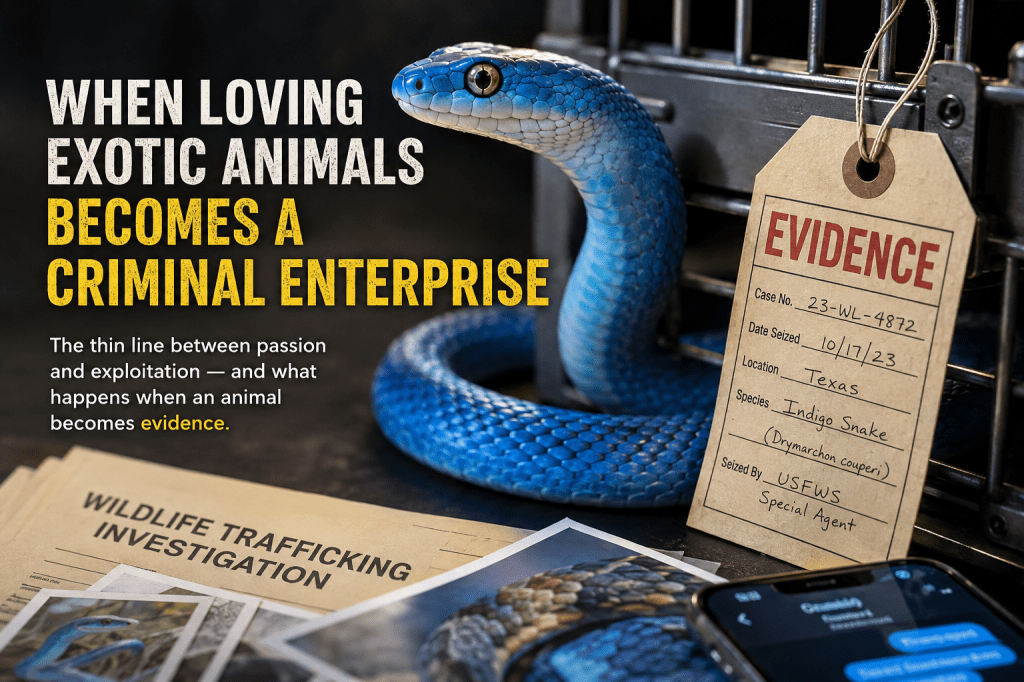
And sometimes the most important piece of evidence is the living animal sitting in a cage.
That creates a problem that is very different from ordinary evidence storage. A computer can be secured. A document can be placed in a file. An object can be packaged and stored until a case is resolved.
An animal still has to eat.
It still needs appropriate housing.
It may need veterinary care.
It may require specialized handling.
And its condition may matter to the investigation.
The U.S. Fish and Wildlife Service and the Association of Zoos and Aquariums have even developed programs focused on caring for animals confiscated from illegal wildlife trade, recognizing that confiscated wildlife needs coordinated care and welfare support while the larger legal process continues (USFWS, 2023). (U.S. Fish and Wildlife Service)
That is one of the reasons I find this particular Wild Wednesday crossover so compelling.
We tend to think of evidence as something inanimate.
But sometimes evidence breathes.
Sometimes evidence eats.
Sometimes evidence requires a veterinarian.
Sometimes evidence is also a victim.
And that distinction matters.
An animal seized during an investigation may be evidence because investigators need to establish what species it is, where it came from, how it was obtained, whether it was legally transported, and whether the person possessing it had the documentation required by law. At the same time, that animal may have been harmed by the very conduct being investigated.
The two ideas are not mutually exclusive.
Texas makes the distinction especially important because “exotic” does not automatically mean “illegal.” Texas Parks and Wildlife Department regulations distinguish among exotic, nongame, endangered, threatened, and otherwise protected species, with different rules applying depending on the animal and the circumstances (Texas Parks and Wildlife Department [TPWD], 2025). (Texas Parks & Wildlife Department)
There are also circumstances in which documentation matters enormously. Texas regulations provide requirements concerning the importation and possession of wildlife, including circumstances involving threatened or endangered animals legally obtained outside the state. Depending on the circumstances, proof of lawful acquisition can include a bill of sale, license tag, permit, or notarized affidavit (TPWD, 2026). (Texas Parks & Wildlife Department)
That means the question shouldn’t simply be, “Is that an exotic animal?”
The better questions are: Where did it come from? How was it obtained? Was it legally transported? Was it legally sold or transferred? Were the necessary permits in place? What documentation exists? And, ultimately, what does the evidence show?
Those questions protect an important distinction that can sometimes get lost in conversations about exotic animals.
Responsible ownership is not the same thing as wildlife trafficking.
Being fascinated by snakes isn’t criminal.
Keeping a legally permitted animal isn’t automatically criminal.
Wanting to learn about an unusual species isn’t exploitation.
The problem begins when animals become commodities in a system built around illegal acquisition, illegal transport, illegal sales, poaching, smuggling, or other unlawful activity.
And the internet has made that system much easier to access.
It has also, ironically, created a trail.
The Fish and Wildlife Service advises people who suspect wildlife trafficking online to preserve information such as the full website address and screenshots of potentially illegal sales. That is a pretty good reminder that something we might dismiss as “just a post” can become relevant evidence when investigators begin reconstructing what happened (USFWS, 2021). (U.S. Fish and Wildlife Service)
That brings me back to Gary De’Snake.
A fictional blue snake can make an audience curious about an animal they might otherwise never think about. But real snakes, turtles, birds, mammals, and other wildlife can become part of a market that stretches across state lines and international borders.
The animal someone sees as fascinating can become inventory to someone else.
The photograph someone sees as cute can be an advertisement.
The rare species someone wants to collect can be the same species someone illegally removed from the wild.
And once money enters the picture, the animal can become part of something much larger than an individual transaction.
That is when Wild Wednesday crosses paths with crime, conservation, and evidence.
Not because exotic animals are inherently dangerous.
Not because everyone who owns one should be viewed with suspicion.
But because sometimes the story behind an animal is more complicated than the animal itself.
Maybe that is the real question worth asking after watching Zootopia 2:
When does fascination become demand, and when does demand become exploitation?
Gary De’Snake is fictional.
The wildlife-trafficking problem isn’t.
And sometimes, the wildest evidence in a criminal investigation isn’t sitting on a shelf.
It’s alive.
References
Texas Parks and Wildlife Department. (2025). Nongame, exotic, endangered, threatened & protected species. (Texas Parks & Wildlife Department)
Texas Parks and Wildlife Department. (2026). Transfer & importation of wildlife. (Texas Parks & Wildlife Department)
U.S. Fish and Wildlife Service. (2021). How to report wildlife crime. (U.S. Fish and Wildlife Service)
U.S. Fish and Wildlife Service. (2021). Wildlife trafficking and the growing online marketplace. (U.S. Fish and Wildlife Service)
U.S. Fish and Wildlife Service. (2023, October 27). New network gives hope to animals trafficked through illegal wildlife trade. (U.S. Fish and Wildlife Service)
Walt Disney Animation Studios. (2025). Zootopia 2. Disney. (Disney Movies)


Leave a Reply