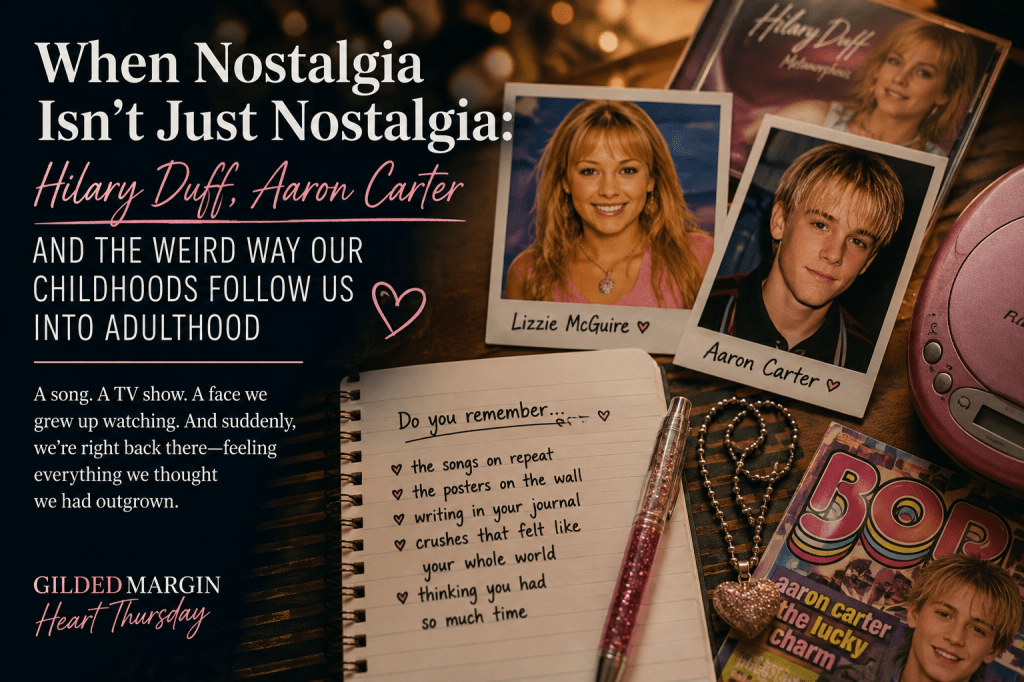
Heart Thursday | Gilded Margin
I was thinking about Hilary Duff the other day, which is probably how I ended up thinking about Aaron Carter, and then somehow ended up thinking about getting older.
That’s how nostalgia works, I guess.
You start with one song or one television show and suddenly you’re remembering an entire version of yourself that you haven’t thought about in years.
For me, Hilary Duff is tied so closely to a particular time in life that it’s almost strange to see her now. I know she’s Hilary Duff. I know she’s grown up. I’ve watched her career continue. I’ve seen her become a mother. I know she has lived an entire life outside of the character that made so many of us know her in the first place.
And yet, somewhere in my brain, she’s still Lizzie McGuire.
I think a lot of people understand that feeling.
You can watch an old episode of Lizzie McGuire and suddenly you’re not watching it as an adult anymore. You’re remembering what it felt like to be that age. Maybe you watched it after school. Maybe you were sitting in your bedroom. Maybe you had a crush on someone. Maybe you were worried about something that seemed like the biggest problem in the world at the time.
You don’t necessarily remember all of those details until something brings them back.
That’s what I think is so interesting about nostalgia. We think we’re remembering a celebrity, a television show, or a song, but a lot of the time we’re really remembering ourselves.
And then there are the people from that time who aren’t here anymore.
Aaron Carter is one of those for me.
He was just part of the landscape of growing up. The music, the magazines, the blond hair, the connection to Nick Carter and the Backstreet Boys. He was one of those young celebrities who seemed to have always been around if you grew up during that period.
Then he died in 2022 at 34.
Thirty-four.
That number hits differently now than it would have when I was younger.
When you’re a kid, 34 sounds like someone who is practically ancient. A completely established adult. Someone who knows what they’re doing and has probably figured life out.
Then you become an adult yourself and realize 34 is really not old at all.
It’s young.
It’s still the beginning of so many things.
And I think that’s part of what makes the death of someone from your childhood hit in such an unexpected way. You’re not sitting there pretending you knew them. You didn’t. Most of us never did.
But they were attached to something you knew.
They were part of a time in your life.
And when they’re gone, it can feel like something from that time is gone with them.
That’s a strange kind of grief.
It’s not necessarily grief for the person as if they were your friend. It’s grief for the memories surrounding them. It’s the realization that the world you remember from childhood isn’t sitting there waiting for you anymore.
The people got older.
The shows ended.
The music changed.
The kids you remember as teenagers are now adults with their own children.
And some of the people you remember aren’t here at all.
I think that’s when nostalgia starts becoming a little more complicated.
When you’re younger, nostalgia is fun. You hear an old song and laugh. You find an old picture and make fun of your hair. You see something from the 1990s or early 2000s and immediately start talking about how much better everything was.
But when you’re older, nostalgia can have a little ache to it.
Because now you understand time.
You understand that you can’t go back.
You understand that some people really are gone.
You understand that there were moments happening around you that you didn’t realize would eventually become memories.
That’s probably the hardest part.
When we were kids, we didn’t know we were living through our childhood.
We were just living.
We didn’t know that the episode we watched after school would someday make us emotional because we haven’t seen it in twenty years.
We didn’t know that a song playing on the radio would eventually transport us straight back to a bedroom, a car ride, a summer, or a person we haven’t spoken to in forever.
We didn’t know that the people we were watching grow up would eventually become part of our own timeline.
That’s something I think about when I see Hilary Duff now.
There is something almost comforting about watching someone who was part of your childhood continue to live and change. She isn’t supposed to look exactly like Lizzie McGuire anymore. Neither are we supposed to look or feel exactly like the people we were back then.
That’s the whole point.
She grew up.
We grew up.
And somehow, we got to watch each other do it from completely different sides of a screen.
Aaron Carter’s story makes that realization much harder because he didn’t get the same amount of time.
There are old videos of him where he’s just a kid. He’s singing, smiling, joking around, doing interviews, completely unaware of everything that will eventually happen in his life.
Watching old footage of someone who has died is a strange experience. They’re alive right there on the screen. They’re talking. They’re laughing. They don’t know what we know.
And maybe that’s why those videos can feel so emotional.
We’re watching someone who doesn’t know the ending.
But we do.
I think there is also something important about remembering that these people were actual people and not just characters in our childhood memories.
We can remember what Hilary Duff meant to us without pretending we know her life.
We can remember Aaron Carter’s music without reducing his entire life to the struggles that became public later.
Celebrity gives us this weird illusion of familiarity. We see so much of someone’s life that it can feel like we know them, when really we’ve only seen the pieces that made it through a camera.
That’s especially important with people who became famous when they were children.
We watched them grow up, but we didn’t actually grow up with them in the way we grew up with our friends and family. We were watching from the outside.
Still, they can become part of our story.
That’s the part I find fascinating.
A celebrity can be a stranger and still be connected to some of your strongest memories.
A song can belong to a summer.
A television show can belong to a bedroom.
An actor can belong to a particular age.
A singer can belong to the person you were before you had mortgages, responsibilities, children, careers, heartbreak, and all the other things adulthood brings with it.
Maybe that’s why we keep going back.
We rewatch the shows.
We listen to the old music.
We look up what happened to the people we used to watch.
We get excited when someone from our childhood appears in a new movie or announces a reunion.
I don’t think that’s necessarily because we want to be young again.
At least I don’t.
There are certain parts of childhood I would happily leave exactly where they are.
But I do like remembering who I was.
There was a version of me who had no idea what adulthood was going to look like. She didn’t know who would stay in her life. She didn’t know who she would lose. She didn’t know which things she would accomplish or which things would completely change her plans.
Honestly, she probably couldn’t have imagined the person I am now.
And I couldn’t have imagined her knowing what I know now.
That’s what these little trips down memory lane do.
They remind us that we’ve already been several different people.
The kid.
The teenager.
The young adult.
The person who thought they had everything figured out.
The person who realized they didn’t.
The person who started over.
The person who kept going.
They’re all still in there somewhere.
So maybe nostalgia isn’t really about wanting the past back.
Maybe it’s about remembering that those versions of us existed.
Maybe that’s why a Hilary Duff song can hit you unexpectedly hard.
Maybe that’s why hearing an Aaron Carter song can make someone stop what they’re doing for a second.
It’s not just the music.
It’s everything attached to it.
It’s who we were when we heard it.
It’s who we were before we knew what was coming.
And maybe there’s something comforting about realizing that even though we can’t go back, that person isn’t completely gone.
She’s still part of me.
Just like those songs are still part of my story.
Just like the shows are still part of my memories.
Just like the people we watched growing up became part of a cultural scrapbook that millions of us carry around without even realizing it.
And maybe that’s the weirdest part of getting older.
One day, you look at the people you grew up watching and realize you’re not just watching them age.
You’re watching time pass.
You see it in their faces.
You hear it in an old song.
You notice it when someone from that era dies.
And suddenly you’re doing the math and wondering how so many years disappeared so quickly.
But then the song ends.
The memory fades.
And you go back to whatever you were doing.
Maybe that’s okay.
Maybe we aren’t supposed to stay in those old versions of ourselves.
Maybe we’re just supposed to visit them every once in a while.
Say hello.
Remember what mattered.
Remember what made us laugh.
Remember the people who were part of that chapter.
And then come back to the life we have now.
Because nostalgia isn’t really asking us to go backward.
Sometimes it’s just reminding us how far we’ve come.


Leave a Reply