Leadership| The Gilded Margin
Accountability is supposed to make an organization better.
It should establish expectations, address misconduct, correct problems, protect the public, and help employees understand where they fell short. In a healthy workplace, accountability builds trust because employees know the rules, understand the process, and believe those standards will be applied fairly.
But accountability can become something very different when it is used to control people.
It can become weaponized.
This can happen in any workplace, but it deserves particular attention in organizations built around hierarchy, authority, public trust, and strict chains of command—including law enforcement.
The problem isn’t that an agency investigates misconduct.
The problem isn’t that an employee can be disciplined or terminated.
The problem isn’t even that an agency communicates about significant misconduct.
The question is how, why, and to whom that information is communicated—and what message employees are expected to take from it.
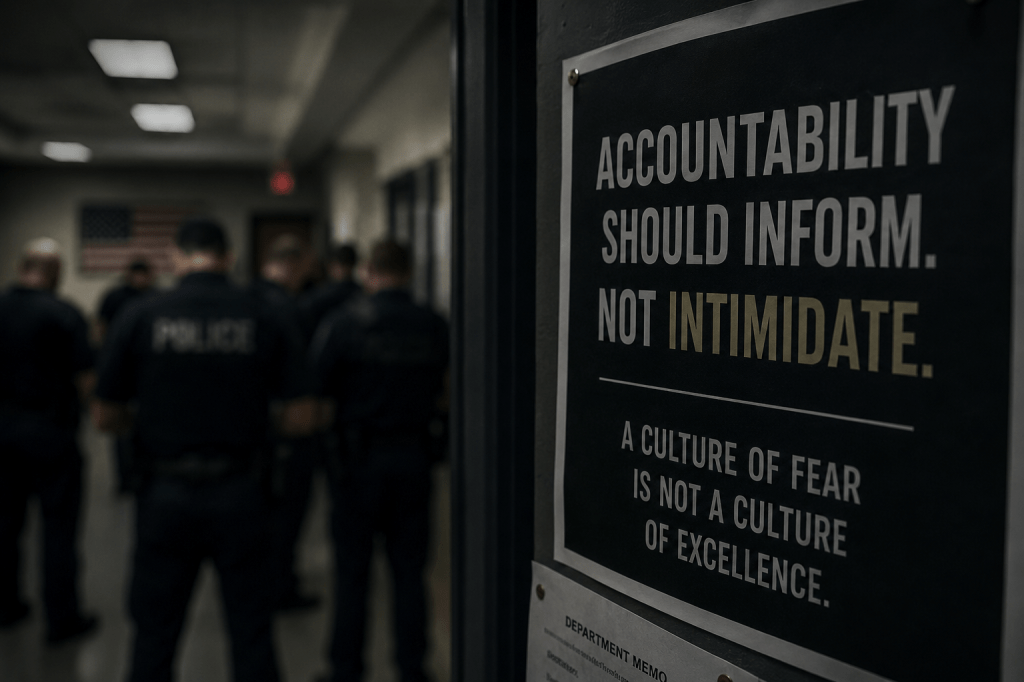
Because there is a difference between accountability and accountability used as intimidation.
When Everyone Gets the Email
Imagine an employee is accused of violating an agency policy.
The matter is investigated. The investigation concludes. Appropriate administrative action is taken.
Leadership then sends a message to the entire department describing what happened, explaining the disciplinary outcome, and reminding everyone that similar conduct will result in consequences.
At first glance, that may sound like accountability.
And sometimes it is.
There can be legitimate reasons to communicate policy violations or organizational changes to an entire workforce. Employees may need clarification about expectations. A problem may reveal a training deficiency. A policy may need to be reinforced.
But now imagine that this becomes a pattern.
Every time an employee makes a significant mistake or becomes the subject of an internal investigation, the entire workforce receives a message about it.
The employee’s conduct becomes a department-wide example.
The punishment becomes part of the lesson.
And eventually employees may stop hearing:
“Here is what we learned.”
Instead, they hear:
“This is what happens to people who get on the wrong side of management.”
That is where accountability can begin to change into control.
Transparency Isn’t the Problem
It is important to make a distinction here.
Transparency is not inherently bad.
Neither is communicating legitimate disciplinary information.
Government agencies have obligations concerning public information, and Texas law establishes specific rules governing the disclosure of certain law-enforcement and personnel records. The Texas Attorney General’s 2026 Public Information Handbook, for example, explains that different rules can apply to police civil-service files and confidential internal personnel files, depending on the circumstances. (Texas Attorney General)
So an agency saying that certain records may be available through a public-information request is not, by itself, evidence of weaponized accountability.
The concern is what happens when transparency becomes a vehicle for intimidation, humiliation, or institutional theater.
There is a meaningful difference between:
“The administrative review has concluded. The agency has taken appropriate action and will be reinforcing the applicable policy.”
and:
“An employee was investigated, disciplined, and removed. If anyone wants additional information, they may submit a public-information request.”
Both statements could potentially communicate legitimate information.
But the second can feel very different when employees have repeatedly watched coworkers become the subject of department-wide announcements.
The issue isn’t simply what was disclosed.
It is also why it was disclosed and what purpose the communication serves.
Internal Affairs: Accountability or Example-Making?
Internal Affairs investigations serve an important function.
Allegations need to be investigated.
Misconduct that is substantiated needs to be addressed.
Policies need to be enforced.
Employees need to be held to professional standards.
But leadership should also ask:
What is the purpose of telling the entire workforce about the outcome?
If the purpose is organizational learning, that’s valuable.
For example:
“An administrative investigation identified a misunderstanding regarding Policy X. The agency is reinforcing the policy through additional training so expectations are clear.”
That message gives employees something useful.
It identifies a problem.
It clarifies the standard.
It creates an opportunity to prevent recurrence.
But consider a different approach:
The entire department receives a summary of an employee’s alleged misconduct, the investigation, the finding, and the resulting discipline.
The employee is no longer simply an employee who was held accountable.
They have become the example.
Everyone else becomes the audience.
And the lesson can quietly shift from:
“Let’s learn from this.”
to:
“Don’t be the next person they make an example of.”
That distinction is at the heart of weaponized accountability.
Discipline Isn’t the Problem Either
Sometimes an employee should be disciplined.
Sometimes an employee should be terminated.
Organizations cannot function without consequences for serious misconduct.
The existence of discipline does not make a workplace toxic.
The question is what leadership does with the discipline.
Healthy accountability asks:
- What happened?
- What policy applies?
- Was the expectation clear?
- Was the employee properly trained?
- Was the conduct intentional, negligent, or accidental?
- Were similar situations handled consistently?
- What response is proportional?
- What can the organization learn?
Weaponized accountability asks a different question:
- How do we make sure everyone sees what happened?
That shift is significant.
One approach is focused on resolution and improvement.
The other can become focused on deterrence through fear.
The Chilling Effect
Fear changes workplace behavior.
An employee who feels psychologically safe may think:
“If I see a problem, I should report it.”
An employee who has watched coworkers become the subject of department-wide disciplinary announcements may think:
“If I report this, could I become part of the problem?”
A healthy employee thinks:
“I made a mistake. I need to tell someone so we can fix it.”
A fearful employee thinks:
“If I admit this, will my mistake become the next department-wide email?”
A healthy employee thinks:
“I disagree with this decision. I should respectfully raise my concern.”
A fearful employee thinks:
“Maybe it’s safer to keep my mouth shut.”
That is the chilling effect.
And it can be incredibly damaging.
Eventually, People Stop Speaking
Employees may stop asking questions.
They may stop volunteering information.
They may stop admitting mistakes.
They may stop challenging questionable decisions.
They may stop reporting problems unless absolutely necessary.
They become defensive.
They document everything to protect themselves.
They communicate less.
They trust leadership less.
And leadership may mistakenly interpret that silence as improvement.
It isn’t.
Silence can be a symptom of fear.
An employee who doesn’t report a problem isn’t necessarily telling you there is no problem.
They may simply have decided that reporting it isn’t worth the risk.
Why This Matters in Law Enforcement
Law enforcement depends on people speaking up.
Officers need to be able to question decisions.
Supervisors need employees to identify operational problems.
Evidence personnel need to report discrepancies.
Dispatchers need to communicate concerns.
Investigators need to challenge assumptions.
Civilian employees need to identify weaknesses in procedures.
Employees need to be able to say:
“I don’t understand.”
“I think there is a problem.”
“I made a mistake.”
“This doesn’t seem right.”
“Can we look at this another way?”
Those conversations are not signs of a weak organization.
They can be signs of a healthy one.
An agency that teaches employees that questioning authority can result in scrutiny or punishment eventually loses access to valuable information.
People begin protecting themselves instead of improving the organization.
Accountability Should Travel Upward, Too
One of the clearest tests of organizational culture is whether accountability applies to leadership.
It is easy to hold an employee accountable.
It is harder to ask whether a supervisor made a bad decision.
Whether a policy is poorly written.
Whether training was inadequate.
Whether expectations were unclear.
Whether leadership contributed to the conditions that produced the mistake.
A healthy organization can ask those questions.
A fear-based organization looks for someone to blame.
And when accountability only travels downward, it stops feeling like accountability.
It starts feeling like power.
Selective Accountability Makes It Worse
Another major warning sign is perceived inconsistency.
Imagine three employees engage in substantially similar conduct.
One receives significant discipline.
Another receives coaching.
A third appears to experience no meaningful consequence.
There may be legitimate differences between the cases. Employees rarely have access to every fact involved in a personnel decision.
But when employees repeatedly perceive inconsistent enforcement, trust begins to disappear.
People start wondering whether the rules are actually the rules—or whether the rules are tools that can be selectively deployed.
That creates resentment.
It creates division.
And eventually, it creates a workforce that is constantly watching leadership rather than focusing on the mission.
The Five-Question Test
Before sending a department-wide communication about an employee’s misconduct, investigation, or discipline, leadership should ask five questions.
1. Does everyone actually need this information?
Is the communication operationally necessary?
Or does leadership simply want everyone to know what happened?
2. Is the purpose education or intimidation?
Are employees being taught something useful?
Or are they being shown an example of punishment?
3. Would the same communication be sent regardless of who was involved?
Consistency matters.
If information is routinely communicated only when certain employees are involved, employees will notice.
4. Is the communication factual and professional?
There is a difference between explaining an organizational issue and making an employee the subject of institutional humiliation.
5. What behavior will this communication produce?
Will employees become more willing to report problems?
Or will they become more afraid of becoming the next example?
That last question may be the most important.
The Goal Isn’t an Organization Without Consequences
None of this means organizations should stop investigating misconduct.
It doesn’t mean employees shouldn’t be disciplined.
It doesn’t mean law-enforcement agencies shouldn’t terminate employees when circumstances warrant it.
And it doesn’t mean agencies should avoid transparency.
Accountability is necessary.
But accountability should be designed to produce ethical behavior, professional growth, organizational learning, and public trust.
It should not require employees to be afraid of leadership.
Because fear can produce obedience.
It can produce silence.
It can even produce the appearance of a highly controlled organization.
But it does not necessarily produce integrity.
What Does a Healthy Culture Look Like?
A healthy organization doesn’t tell employees:
“Don’t screw up because we’ll make an example out of you.”
It tells them:
“Know the standard. Follow the standard. If something goes wrong, tell us so we can address it.”
It doesn’t use every disciplinary action as a warning.
It uses mistakes and misconduct as opportunities to examine policies, training, supervision, communication, and individual responsibility.
It doesn’t eliminate consequences.
It makes consequences fair, consistent, proportionate, and purposeful.
And it understands that employees are human beings—not examples to be displayed for organizational effect.
Accountability vs. Fear
Perhaps the simplest way to recognize the difference is to ask what employees believe will happen when they make a mistake.
In a healthy culture, they think:
“I need to own it, report it, and fix it.”
In a fear-based culture, they think:
“I need to make sure nobody finds out.”
One creates learning.
The other creates concealment.
One creates trust.
The other creates anxiety.
One strengthens an organization.
The other slowly erodes it from the inside.
Accountability should answer:
- What happened?
- Why did it happen?
- What standard applies?
- What needs to be corrected?
- How do we prevent it from happening again?
It should not become:
Who can we make an example of?
Because when employees start believing that every mistake, disagreement, or investigation could become the next department-wide warning, accountability has stopped being merely a professional standard.
It has become a mechanism of control.
And once employees begin working primarily to avoid becoming the next example, the organization hasn’t necessarily created a more accountable workforce.
It has created a workforce that is afraid.
And there is a very big difference.


Leave a Reply