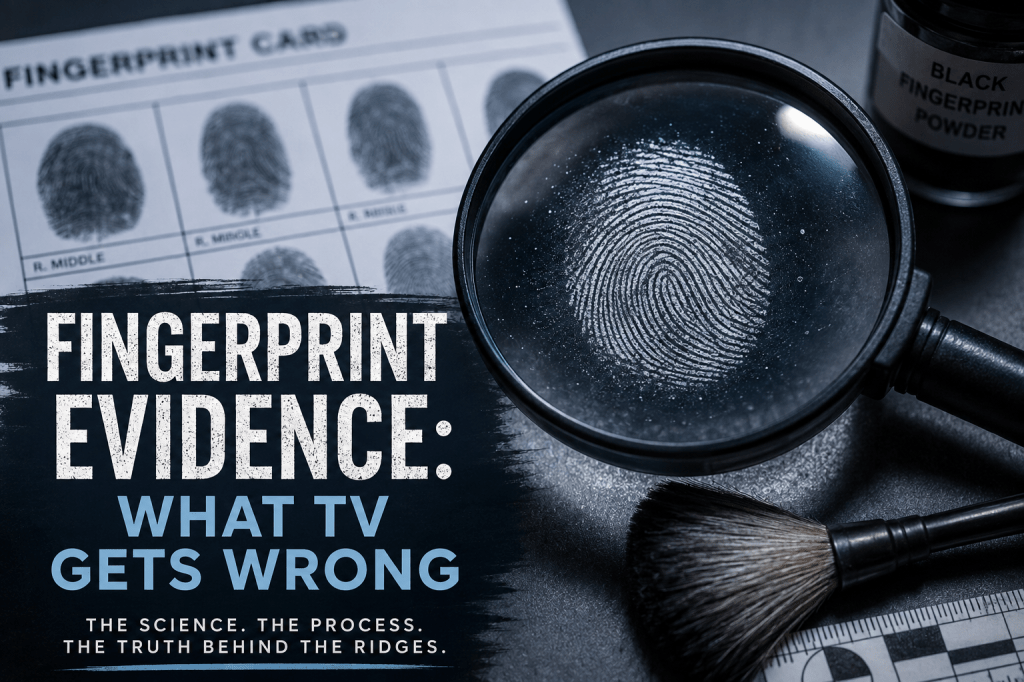
Brain Day| The Gilded Margin
If you have ever watched a crime show, you probably know the scene.
A detective finds a fingerprint at a crime scene. The evidence technician lifts it, runs it through a computer, and suddenly the screen flashes:
MATCH FOUND!
Cue dramatic music.
Case closed.
Except fingerprint evidence rarely works that way.
Real fingerprint examination is much more deliberate. It involves questions about the quality of the impression, the type of print recovered, the information actually visible in the ridge detail, the comparison process, and the limitations of the technology being used.
That does not make fingerprint evidence less interesting.
Honestly, it makes it more interesting.
A fingerprint is not simply a name waiting to be revealed by a computer. It is evidence that has to be documented, preserved, evaluated, compared, and interpreted.
And there is a lot television leaves out.
First: Not Every Fingerprint Is the Same
One of the biggest misconceptions about fingerprint evidence is that every print found at a scene is immediately suitable for comparison.
It isn’t.
Investigators may encounter several different kinds of impressions.
Latent Prints
A latent print is generally an impression that is not readily visible to the naked eye and may require processing or enhancement to be observed.
These can be left when the natural oils, sweat, or other substances on the friction ridge skin transfer onto a surface.
Depending on the surface and circumstances, investigators may use different development techniques to make the ridge detail visible.
But developing a print does not automatically make it a good print.
A beautifully developed impression can still contain limited ridge detail.
Known or Exemplar Prints
A known print, sometimes called an exemplar print, is collected from a person under controlled circumstances so that it can be used for comparison.
This is fundamentally different from a questioned or latent impression recovered from a scene.
The examiner is not simply asking:
“Does this look like John’s fingerprint?”
The question is whether the friction ridge information in the questioned impression is consistent with the known impression to the degree required for an identification conclusion.
Patent and Plastic Impressions
There are also visible or three-dimensional impressions.
A patent print may be visible because the finger transferred a substance such as blood, ink, grease, or another material.
A plastic print is a three-dimensional impression left in a soft material such as wax, putty, soap, or another pliable surface.
Different types of impressions create different examination challenges.
So before anyone starts talking about a “match,” someone has to determine exactly what kind of evidence they are looking at.
Fingerprint Patterns Are Only the Beginning
You may remember learning about the three basic fingerprint pattern groups:
- Loops
- Whorls
- Arches
Those categories are useful.
But they are not enough to identify a person.
Two people can have fingerprints that fall into the same broad pattern category. Millions of people have loops. Millions have whorls. A pattern classification does not function like a fingerprint-specific serial number.
The examination becomes much more detailed when an examiner evaluates the actual friction ridge characteristics within the impression.
That brings us to minutiae.
What Are Minutiae?
Minutiae are individual ridge characteristics used during fingerprint examination.
Depending on the terminology and examination context, these can include features such as ridge endings and bifurcations, along with other ridge events and relationships.
Imagine looking at a fingerprint as a tiny landscape.
The broad pattern is the terrain.
The individual ridge characteristics are the landmarks.
An examiner evaluates those characteristics and, importantly, their relationships to one another.
This is one reason the television version of fingerprint identification is misleading.
It is not simply:
“There are twelve matching dots, therefore MATCH.”
The actual examination considers the quality and quantity of information available, distortion, clarity, and the overall agreement of the observed ridge detail.
Quality Matters More Than Television Suggests
A fingerprint recovered from a crime scene is not necessarily a perfect fingerprint.
It may be:
- Smudged
- Partial
- Distorted
- Overlapping another impression
- Deposited on an irregular surface
- Affected by movement
- Too faint
- Too dark
- Missing significant ridge detail
- Altered by the processing method
Even the way a finger contacts a surface can change what an impression looks like.
Pressure can distort ridge detail.
Movement can stretch or blur it.
The surface itself can affect the quality of the impression.
This is why “I found a fingerprint” and “I found an identifiable fingerprint” are two very different statements.
The first describes evidence.
The second describes an evaluation of that evidence.
Then Comes Comparison
Once an impression has been developed, documented, and determined to contain potentially useful ridge information, an examiner can begin the comparison process.
A common framework used in friction ridge examination is ACT-V:
Analysis
Comparison
Evaluation
Verification
The basic idea is that the examiner first evaluates the questioned impression, then compares it with a known impression when appropriate, evaluates the significance of the observed similarities and differences, and has the conclusion independently verified according to the applicable procedures.
That is considerably less dramatic than a television screen announcing the suspect’s name.
But it is much closer to the actual work.
Analysis Comes Before the “Match”
The examiner first has to understand what information is actually present.
Is the impression sufficient for comparison?
Which areas contain usable ridge detail?
Is there distortion?
Are apparent differences potentially caused by deposition conditions?
Could the apparent similarity simply be the result of limited information?
These questions matter because the examiner is working with evidence that may be incomplete.
The goal isn’t to force an identification.
The goal is to determine what conclusion the evidence supports.
Sometimes that conclusion may be an identification.
Sometimes it may be an exclusion.
Sometimes there simply isn’t enough information to reach either conclusion.
And that last category is important.
Inconclusive is a legitimate result.
AFIS Is Not a Fingerprint Psychic
This may be one of the biggest things television gets wrong.
AFIS—the Automated Fingerprint Identification System—can be an extraordinarily useful investigative tool.
But it does not simply look at a crime-scene fingerprint and announce:
“This is Bob Smith.”
AFIS searches databases and generates candidate possibilities based on the available friction ridge information.
The resulting candidate list is not, by itself, the final forensic conclusion.
A trained examiner evaluates the questioned impression against the candidate’s known prints.
In other words:
AFIS can help find a candidate. It does not replace the examination.
That distinction is critical.
The computer is helping narrow the search.
A human examiner still has to evaluate the actual evidence.
And Yes, Humans Are Still Involved
There is an understandable assumption that fingerprint identification is completely objective because fingerprints are physical evidence.
But the evidence itself and the interpretation of the evidence are two different things.
The ridge detail exists physically.
The examiner has to interpret what is visible, what is distorted, what is comparable, and what conclusion the available information supports.
That is why training, competency, documentation, quality assurance, verification, procedures, and appropriate laboratory practices matter.
It is also why fingerprint examination should never be reduced to the phrase:
“The computer found a match.”
The computer did not testify.
The computer did not examine the ridge detail.
The computer generated information that can assist the investigative process.
A Fingerprint Doesn’t Tell You Everything About the Person Who Left It
Another television problem is the tendency to treat a fingerprint as if it answers every investigative question.
It doesn’t.
A fingerprint may provide evidence that a particular person’s friction ridge detail is associated with an impression.
That does not automatically tell investigators:
- When the impression was deposited
- Why the person touched the surface
- What the person was doing
- Whether the contact was criminal
- Whether the person was present during the crime itself
- How the impression got there
Context still matters.
A fingerprint on a door, for example, does not automatically establish the circumstances under which that door was touched.
Evidence answers questions.
It also has limitations.
Good forensic work requires being honest about both.
The “Fingerprint Match” Is Actually the Beginning of More Questions
Suppose an examiner reaches an identification conclusion.
That can be important evidence.
But investigators still have to place that evidence into the larger case.
What was the surface?
Where was it located?
Was the person’s presence expected?
Was the object commonly handled?
What other evidence exists?
Does the fingerprint evidence support or contradict the broader investigative picture?
Forensic evidence becomes meaningful within context.
A fingerprint is a piece of the puzzle—not the entire puzzle.
Why This Matters in Property and Evidence
For those of us who work around evidence, the story does not begin when an examiner places a print under a microscope.
It begins much earlier.
Evidence has to be collected, packaged, labeled, documented, transported, stored, accessed, preserved, and ultimately maintained in a way that protects its integrity.
That chain matters.
Because even the most sophisticated examination in the world cannot fix evidence that was improperly handled, inadequately documented, contaminated, damaged, or otherwise compromised before it reached the examiner.
The glamorous part of forensic science is often the examination.
The less glamorous part is everything that makes that examination possible.
And that part matters enormously.
So, What Does TV Get Wrong?
Quite a lot.
Television makes fingerprint evidence look like a button.
Real fingerprint examination is a process.
TV gives us perfect prints.
Real crime scenes give examiners partial, distorted, messy impressions.
TV makes pattern classification look like identification.
Real examination goes far beyond loops, whorls, and arches.
TV makes AFIS look like an all-knowing database.
AFIS actually assists by searching databases and generating candidates.
TV makes the conclusion instantaneous.
Real examination requires analysis, comparison, evaluation, and appropriate verification.
And perhaps most importantly, TV makes uncertainty look like failure.
Real forensic science understands that “inconclusive” can be the scientifically appropriate answer when the evidence does not support something stronger.
That isn’t a weakness.
That’s the discipline.
The Fingerprint Is Only as Good as the Question We Ask of It
Fingerprint evidence is fascinating precisely because it sits at the intersection of biology, technology, observation, documentation, and human interpretation.
A ridge pattern can be incredibly informative.
But information is not the same thing as certainty.
The quality of the impression matters.
The amount of ridge detail matters.
The comparison matters.
The methodology matters.
The examiner matters.
And the context matters.
So the next time a crime show dramatically zooms in on a fingerprint and announces “MATCH FOUND!”, remember:
That’s the beginning of the conversation—not the end.
And for me, the timing of this topic is especially fitting.
Next week, I’m heading into Advanced Fingerprint Comparison training, and I am genuinely looking forward to learning more about the science, methodology, limitations, and practical examination of fingerprint evidence.
Because the more we learn about evidence, the more interesting the evidence becomes.
And sometimes the real story is much better than television.
 The Gilded Margin
Leave a comment