Animal Safety| The Gilded Margin
A pet-food recall usually brings one immediate question to mind:
Is my pet safe?
That is absolutely the right first question.
But a recent recall involving Mars Petcare and PEDIGREE® dog food raised another question for me—one that has less to do with what’s inside the can and more to do with what happens after a company determines that a product should never reach a customer.
That question is surprisingly familiar to anyone who works around property, evidence, records, or chain-of-custody systems:
Can you prove where the product went and what ultimately happened to it?
The part of the recall that caught my attention
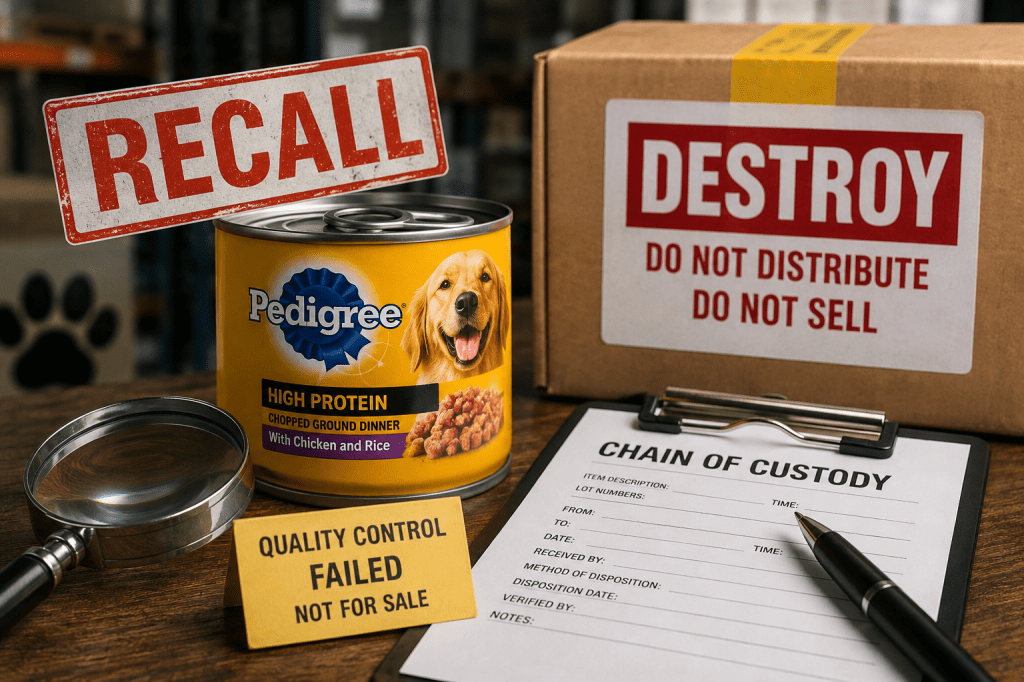
According to the U.S. Food and Drug Administration (FDA, 2026), Mars Petcare recalled two lots of PEDIGREE High Protein Chopped Ground Dinner With Chicken and Rice Flavor because the products could contain foreign material, including small pieces of metal.
The company stated that the affected products had not been intended for sale. They had failed Mars’ quality and safety standards and were sent to a third-party vendor for destruction.
The problem?
Some of that product was apparently diverted and later entered the marketplace.
That changes the story.
Now we’re not only talking about quality control.
We’re talking about control of the product after the quality-control decision has already been made.
What happens when something is supposed to be destroyed?
This is where my Property & Evidence brain kicks in.
When something is placed into a destruction process, there should be a clear trail.
Not necessarily because the item is legally considered evidence, but because somebody has made a decision about its status.
It has gone from:
Product → identified problem → removed from commerce → controlled disposition → destruction.
Every step creates an opportunity for something to go wrong.
Who had custody?
Who transported it?
Who received it?
How was the product identified?
Was the lot information preserved?
Where was it stored?
Who could access it?
What records documented the transfer?
And perhaps the biggest question:
How was the destruction actually verified?
Those questions sound a lot like the questions asked when something moves through an evidence system.
The circumstances are obviously different. A recalled can of dog food is not a police evidence item.
But the underlying principle is familiar:
If the physical item matters, the system has to be able to account for it.
A third-party handoff creates another link
Using a third-party destruction vendor isn’t unusual. Companies routinely rely on outside businesses for transportation, disposal, destruction, recycling, and other services.
But every outside handoff creates another point in the chain.
The manufacturer has to know what it released.
The vendor has to know what it received.
There needs to be a way to reconcile what was transferred with what was ultimately destroyed.
And the manufacturer needs confidence that the final disposition actually occurred.
That doesn’t mean every destruction process needs to look like a police evidence room.
It does mean that the higher the potential consequence of something being diverted, the more important those controls become.
In this case, Mars reported that the affected products were sent for destruction but were later discovered to have been diverted. The company said it was working with authorities to determine how the product entered the marketplace (FDA, 2026).
There are still questions about exactly how that happened.
Those questions shouldn’t be answered with speculation.
But the situation itself demonstrates why “sent for destruction” and “destroyed” are two different things.
The paperwork isn’t the physical item
This is probably the biggest lesson for me.
A record can say something was transferred.
A record can say something was destroyed.
A certificate can say something was disposed of.
But documentation is only one part of accountability.
If the physical product goes somewhere it shouldn’t, the existence of paperwork doesn’t make that problem disappear.
That’s true in Property & Evidence, and it is true in other industries.
The documentation should support what actually happened to the physical item.
Otherwise, you’re left with two different stories:
The record says one thing.
The physical reality says another.
That’s when a control system has failed.
Animal safety is still the reason this matters
It’s easy to get so interested in the systems issue that we forget why the recall happened in the first place.
This is pet food.
People are feeding these products to animals they love.
The FDA reported that the recalled lots could contain foreign material that could potentially cause injury if consumed (FDA, 2026).
That makes the diversion issue more than an interesting supply-chain problem.
A product that had already been determined unsuitable for commerce was apparently able to make its way back into commerce.
That’s the part that deserves attention.
Not because it means pet food as a whole is unsafe.
And not because one recall proves that manufacturers cannot control their products.
It doesn’t.
It does, however, provide a real-world example of why post-recall controls matter.
Quality control doesn’t necessarily end with the recall
We often think of a recall as the end of the process:
Find the problem.
Announce the recall.
Get the product off the shelves.
But what happens to the product that has already been pulled?
That’s another system.
And that system needs its own controls.
A strong process should be able to answer questions like:
- What products were identified?
- How were they segregated?
- How much product was removed?
- Who took custody?
- Where did it go?
- Who was authorized to handle it?
- How was the final disposition documented?
- Can the company reconcile what was supposed to be destroyed with what was actually destroyed?
Those questions aren’t about blaming someone before the facts are known.
They’re about designing systems that make diversion harder to accomplish and easier to detect.
Why I think this belongs on the Animal Radar
Animal safety isn’t only about ingredients, contamination, recalls, or veterinary consequences.
Sometimes the story is about the system surrounding the animal product.
A recall tells us that something went wrong.
The chain of custody can help us understand what happened next.
And that matters far beyond pet food.
The same basic questions show up whenever something needs to be controlled from one point to another:
Who had it?
Where was it?
Who moved it?
What happened to it?
And can we prove it?
That’s why this recall caught my attention.
A can of dog food isn’t evidence.
But when an unsafe product is removed from commerce and placed into a destruction process, the accountability questions start looking surprisingly familiar.
And maybe that’s the bigger lesson.
Quality control doesn’t end when you identify the bad product.
Sometimes, that’s when the chain of custody begins.
References
U.S. Food and Drug Administration. (2026). Mars Petcare US voluntarily recalls two lots of PEDIGREE® canned dog food due to potential foreign material. U.S. Department of Health and Human Services.
U.S. Food and Drug Administration. (2026). Recalls & withdrawals. Center for Veterinary Medicine, U.S. Department of Health and Human Services.


Leave a Reply