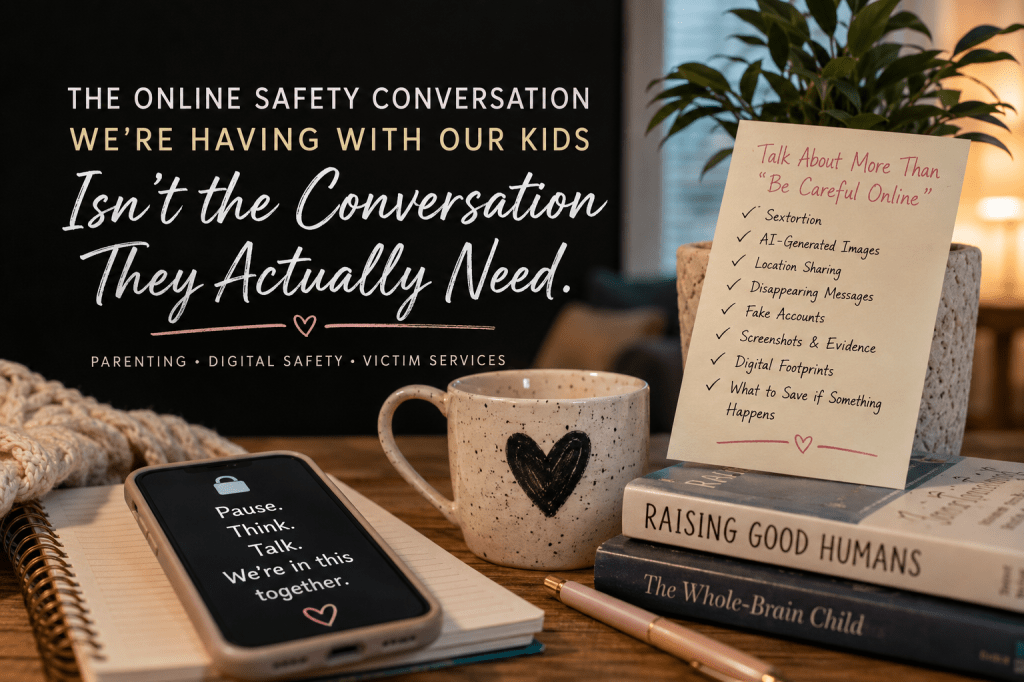
Heart Thursday| The Gilded Margin
We have all had some version of the online safety conversation with our kids.
Don’t talk to strangers.
Don’t give people your address.
Don’t post pictures you wouldn’t want your teacher to see.
Be careful what you click.
Those conversations still matter. But the internet our children are growing up in has changed faster than many of our parenting conversations have.
And there is a growing gap between what parents think they are talking about and what children may actually be encountering online.
A recent report from Australia’s eSafety Commissioner found that 93% of parents and caregivers said they discuss online safety with their children. That sounds encouraging. But when researchers looked at specific emerging risks, the numbers dropped dramatically. Only 8% reported discussing sexual extortion, 11% discussed how generative artificial intelligence can be used or misused, and 26% discussed algorithmic influence. (eSafety Commissioner, 2026a).
That distinction matters.
Because telling a child to “be safe online” is not the same thing as teaching them what to do when someone creates a fake account using their name, threatens to release an intimate image, sends them an AI-generated sexual image, tracks their location, or disappears into a disappearing-message app after something frightening happens.
The conversation has to become more specific.
Our kids are navigating a different internet
When many of us learned about internet safety, the concern was largely about strangers.
Today, the person on the other side of the screen might not be a stranger at all.
It could be someone from school.
Someone they met through gaming.
Someone who appears to be their age.
Someone using a fake account.
Someone who has a photograph of them.
Someone who knows where they go to school.
Or someone who has figured out that fear, embarrassment and secrecy are powerful tools.
Sexual extortion, sometimes called sextortion, is one example. A person may obtain or convince someone to send an intimate image and then threaten to share it unless the victim sends money, additional images or does something else they demand. The important thing for parents to understand is that this is not simply a child making a “bad decision.” It can become a pattern of coercion and abuse.
The eSafety Commissioner specifically advises victims not to pay or send additional images and recommends preserving evidence before blocking or deleting accounts. (eSafety Commissioner, 2026b).
That is a very different conversation from “don’t send nudes.”
It is a conversation about what happens after something goes wrong.
And that is the part I think we need to talk about more.
AI has changed the rules again
Generative AI has made the digital safety conversation even more complicated.
A photograph does not necessarily have to be real to cause real harm.
Images can be manipulated. Faces can be placed into fabricated sexual imagery. Voices can be generated or altered. Someone can create something that looks convincing enough to cause embarrassment, bullying, threats or reputational damage even though the underlying event never happened.
For a child, the distinction between “real” and “fake” may not make the emotional impact disappear.
Someone can look at an image and believe it.
Other kids can share it.
A screenshot can circulate.
A fake account can be created.
And suddenly a child is dealing with something that did not happen but is nevertheless hurting them.
That means children need to know something parents often need to hear, too:
You do not have to prove that something is real before you ask for help.
If your child shows you something disturbing, start with the child—not the technology.
- Are you safe?
- What happened?
- Who sent this?
- Do you know this person?
- Did they threaten you?
- Is anyone asking you for money or more pictures?
Those questions are far more useful than immediately asking, “Why would you do that?”
Location sharing is information, too
We tend to think about personal information as names, addresses and phone numbers.
But location is personal information.
A child may be sharing their location through a social media app, a family location service, a gaming platform, photographs, check-ins or other device settings without thinking of it as “giving someone my location.”
Even a photograph can reveal more than intended.
Where was it taken?
What school is in the background?
Is there a street sign?
Is the child’s uniform visible?
Is the same park, house or neighborhood appearing repeatedly?
Location information can become especially concerning when combined with other pieces of information.
The eSafety Commissioner notes that location can be revealed through device GPS, location services, shared accounts, social media check-ins and other tracking technologies. (eSafety Commissioner, 2025).
So instead of simply telling children not to share their address, we should teach them to ask:
What could someone figure out about me from everything I am posting—not just this one post?
Disappearing messages do not mean disappearing consequences
This is another conversation worth having.
Some apps are designed around disappearing content. That can create a false sense of security.
Children may think:
“It disappears.”
Therefore:
“No one can save it.”
That is not necessarily true.
Someone can screenshot.
Someone can photograph a screen with another device.
Someone can record what is happening.
Someone can forward information before it disappears.
And even when a message disappears from one person’s screen, another copy may exist somewhere else.
This is why the old rule still applies in a new way:
If you would be devastated by someone else having it, think very carefully before sending it.
But again, we have to be careful about turning that into blame.
If a child has already sent something, the next conversation should not be a lecture about their poor judgment.
It should be:
“Okay. Let’s figure out what happened and what we can do next.”
Fake accounts can be more than annoying
A fake account pretending to be your child may sound like a social media nuisance.
Sometimes it is.
Sometimes it is something more serious.
A fake account can be used for harassment, impersonation, grooming, fraud, sexual exploitation, stalking or reputational harm.
Parents should teach children to recognize that an account can look legitimate without actually belonging to the person it claims to represent.
Look at the username.
Look at the account history.
Look at mutual connections.
Look for inconsistencies.
And if something feels wrong, stop engaging.
The goal isn’t to make children suspicious of everyone.
It is to make them comfortable pausing when something doesn’t make sense.
Screenshots are not just for drama
Here is where my Property & Evidence brain kicks in.
When something serious happens online, the instinct may be to delete everything.
Delete the conversation.
Block the person.
Delete the account.
Throw the phone across the room.
I understand the instinct.
But if something potentially criminal or abusive has happened, evidence may matter.
The eSafety Commissioner recommends preserving information such as usernames, profile URLs, dates and times, the platform involved, threatening messages and other details that establish what happened. (eSafety Commissioner, 2026c).
There is an important caveat for parents: do not save or redistribute illegal sexual material involving minors. In those circumstances, parents should preserve identifying information about where the material was located and report it through the appropriate channels rather than downloading or circulating the material. (eSafety Commissioner, 2026c).
And remember that screenshots are not always the only option. Some apps notify users when screenshots or recordings are taken. In some circumstances, photographing the screen with another device may be safer or more appropriate. (eSafety Commissioner, 2025).
The evidence conversation should be simple:
Don’t make the situation worse trying to erase it. Get help figuring out what needs to be preserved.
The digital footprint conversation needs to grow up, too
We have spent years telling kids:
“Don’t post anything you wouldn’t want your future employer to see.”
That advice isn’t wrong.
But it is incomplete.
A digital footprint isn’t just what your child intentionally posts.
It can include photographs other people post.
Comments.
Tagged locations.
Group chats.
Gaming usernames.
Old accounts.
Public profiles.
Screenshots.
Shared videos.
AI-generated material.
Searchable information.
And information that other people can assemble from seemingly harmless pieces.
Children need to understand that privacy isn’t simply about hiding something embarrassing.
Privacy is about controlling information about yourself.
That is a much more powerful lesson.
And there is another change happening in parenting
Interestingly, the digital shift isn’t happening only with children.
A 2026 exploratory study by Sharmin and Afrin examined why some mothers are moving away from Facebook parenting groups and toward large language models such as ChatGPT and Gemini when they need advice.
The study involved 109 mothers and found that 41.3% reported avoiding Facebook parenting groups because they anticipated judgment. The researchers identified privacy and exposure, social judgment, and the convenience of quick, structured support as major themes. (Sharmin & Afrin, 2026).
That finding is fascinating because it says something about parenting in 2026.
Parents are looking for places where they can ask questions without feeling watched.
Without someone screenshotting their question.
Without someone they know recognizing their family.
Without ten strangers telling them what a terrible parent they are.
AI can feel private and convenient.
But there is an important distinction between privacy and safety.
A parent may feel comfortable asking an AI system a question, but that does not mean sensitive information should automatically be entered into it. Parents still need to think carefully about what identifying information, photographs, medical information, school information or other private details they share with any digital service.
The answer to one technology problem cannot simply be another technology.
We still need people.
So what should we actually teach our kids?
Maybe the new online safety conversation sounds less like a list of rules and more like a set of skills.
Teach them to recognize manipulation.
Teach them that someone threatening them is not automatically someone they have to obey.
Teach them that fake accounts exist.
Teach them that location is information.
Teach them that disappearing messages can still be captured.
Teach them that screenshots can travel.
Teach them that AI can create convincing things that never happened.
Teach them that asking for help early is a strength.
And, perhaps most importantly, teach them that coming to you will not automatically make the situation worse.
That last one may be the most important safety tool we have.
Because if a child believes the first thing that will happen is that their phone will be confiscated, their internet access will disappear and their parent will be furious, they may decide silence is safer.
Silence is exactly what a person exploiting them wants.
If something happens, start here
If your child comes to you with something serious, try to slow the moment down.
Don’t immediately delete everything.
Don’t forward the material to relatives or friends.
Don’t confront the suspected offender yourself.
Don’t pay a blackmailer.
Don’t send additional images.
Don’t promise your child that you can make everything disappear.
Instead:
Get your child somewhere safe.
Listen.
Preserve relevant information safely.
Document what happened.
Report through the appropriate platform, law-enforcement agency or specialized reporting service.
And remember that your child may be embarrassed, frightened or convinced that this is somehow their fault.
They need to hear otherwise.
“You are not in trouble. I’m glad you told me. We’re going to figure this out together.”
That sentence may do more for their safety than a hundred lectures about screen time.
The conversation we need to have
The goal isn’t to raise children who are afraid of the internet.
The internet is where they learn, create, socialize, play, explore and eventually work.
The goal is to raise children who understand that the digital world is still a real world.
People can manipulate them there.
People can hurt them there.
People can impersonate them there.
And sometimes, digital harm becomes very real-world harm.
The 93% statistic from Australia’s eSafety research is encouraging because it tells us parents are talking.
Now we need to make the conversation better.
Not just:
“Be careful online.”
But:
- What would you do if someone threatened you?
- What if someone made a fake picture of you?
- What if someone you know asked you to keep a secret online?
- What if someone created an account pretending to be you?
- What information could someone figure out about you from your posts?
- What should we save if something happens?
And maybe the most important question of all:
- If something happens online, will you know you can come to me?
That is the online safety conversation our kids actually need.
References
eSafety Commissioner. (2025, December). Online safety checklist. Australian Government. (eSafety Commissioner)
eSafety Commissioner. (2026a, June 17). Balancing risk and reward: Parenting in the digital world. Australian Government. (eSafety Commissioner)
eSafety Commissioner. (2026b). Dealing with sexual extortion. Australian Government. (eSafety Commissioner)
eSafety Commissioner. (2026c, May 14). How to collect evidence. Australian Government. (eSafety Commissioner)
Sharmin, S., & Afrin, S. (2026). Avoiding social judgment, seeking privacy: Investigating why mothers shift from Facebook groups to large language models. arXiv. (arxiv.org)
Gilded Margin note: Online safety is not about raising children who never make mistakes. It is about making sure they know what to do—and who to tell—when something goes wrong.


Leave a Reply