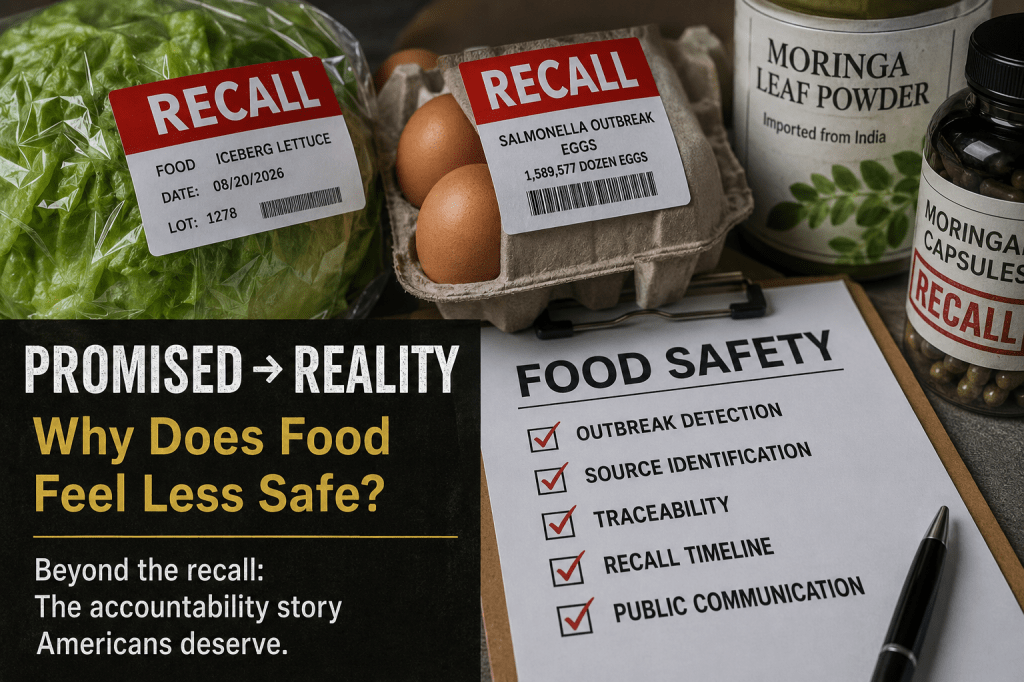
When recalls become the story—and the system behind them becomes the real investigation
Investigation| The Gilded Margin
There is a point where a food recall stops feeling like an isolated warning.
One package of lettuce. One batch of eggs. A few recalled products.
Then another.
And another.
In 2026, Americans have watched a string of highly visible food-safety events involving lettuce, eggs, jalapeños, frozen berries, pet food and other products. The number of recalls alone does not prove that the American food supply has suddenly become more dangerous. But the scale of some outbreaks, the number of people affected and the sheer volume of information consumers are being asked to process are making something else increasingly visible: recall fatigue.
That raises a more interesting question than, “What food was recalled today?”
Are we actually seeing more unsafe food—or are we getting better at finding problems, seeing bigger supply-chain failures when they occur, and dealing with a regulatory system that is itself under pressure?
That is where the investigation gets interesting.
The numbers tell a more complicated story
One of the most significant examples this summer is the Cyclospora outbreak associated with iceberg lettuce sourced from central Mexico.
As of August 20, the FDA reported 10,930 illnesses, 454 hospitalizations and two deaths across 17 states. The agency said its traceback investigation converged on Taylor Farms de Mexico as the supplier of the implicated lettuce and that inspections and sampling were underway. Distribution of recalled products had reached numerous states, including Texas. (U.S. Food and Drug Administration [FDA], 2026a). (U.S. Food and Drug Administration)
That is not a minor recall.
Then there are the eggs.
In July, FDA and CDC investigators linked illnesses in a multistate Salmonella outbreak, in part, to shell eggs recalled by Midwest Poultry Services. As of July 24, the investigation involved 98 reported illnesses and 26 hospitalizations across 17 states. The recalled eggs were produced at farms in Texas, and FDA reported that certain samples collected there tested positive for Salmonella, with whole-genome sequencing showing that some matched the outbreak strain. (FDA, 2026b). (U.S. Food and Drug Administration)
The company ultimately recalled 1,589,577 dozen eggs produced in Texas. (U.S. Food and Drug Administration)
That is the kind of event consumers remember.
Not because every carton of eggs is suddenly dangerous.
But because the potential pathway is enormous.
And then there is the ingredient problem
Food safety becomes even more complicated when the contaminated item isn’t necessarily the thing sitting on the store shelf.
Consider moringa leaf powder imported from India.
In one 2026 Salmonella investigation, FDA and CDC ultimately linked illnesses to recalled dietary supplements containing imported moringa leaf powder. By July 22, the investigation had identified 131 illnesses across 38 states and 36 hospitalizations. FDA testing found Salmonella in samples from products and ingredients, and the agency increased screening of imported moringa powder from India. (FDA, 2026c). (U.S. Food and Drug Administration)
A separate moringa investigation involving MOGO-brand capsules found 34 illnesses in 14 states and 11 hospitalizations. FDA’s traceback determined that the company sourced its moringa leaf powder from India, and FDA investigators inspected both the ingredient supplier and manufacturer. (FDA, 2026d). (U.S. Food and Drug Administration)
This is why “What product was recalled?” is sometimes the wrong question.
The better question is:
Where did the ingredient come from, who handled it, what other products used it, and how quickly can the system identify all of them?
One ingredient can become dozens of products.
One supplier can serve multiple manufacturers.
One manufacturer can distribute nationally.
And suddenly a problem that started somewhere in the supply chain becomes a consumer problem hundreds or thousands of miles away.
The Traceability Question
This is where a policy decision from Washington becomes much more important than it may initially appear.
FDA’s Food Traceability Rule was designed to require certain businesses handling foods on the Food Traceability List to maintain key data elements tied to critical tracking events. The goal is essentially to make the food chain easier to follow—from farm to processor to distributor to retailer—and to allow FDA to obtain those records quickly during an investigation. (FDA, 2026e). (U.S. Food and Drug Administration)
The original compliance date was January 20, 2026.
It isn’t anymore.
The federal government directed FDA not to enforce the rule before July 20, 2028. FDA says it intends to comply with that directive. (FDA, 2026e). (U.S. Food and Drug Administration)
That doesn’t mean the traceability system doesn’t exist.
It means the mandatory enforcement timeline has moved.
And that deserves scrutiny.
Because the point of traceability isn’t merely to help investigators write a better report after people become sick.
It is supposed to help investigators answer a very practical question:
Where did this contaminated food go?
The faster that question can be answered, the faster potentially contaminated products can be removed.
So are Americans actually less safe?
We should be careful here.
A large number of recalls does not automatically mean the food supply is more dangerous than it was in previous years.
Better laboratory technology can identify outbreaks that previously might never have been connected.
Whole-genome sequencing can help investigators determine that illnesses occurring in different states are related.
Public reporting can make recalls much more visible.
And a modern food system is enormous. A single ingredient can travel through a complicated network of importers, manufacturers, distributors, restaurants and retailers.
The FDA’s current outbreak dashboard itself shows multiple investigations involving different pathogens and products, including Cyclospora, Salmonella and E. coli. (U.S. Food and Drug Administration)
So there are at least two competing explanations for what consumers are experiencing:
Maybe there are more problems.
Or maybe we’re better at finding, connecting and publicizing the problems that were always difficult to see.
And there may be some truth in both.
But that still leaves an accountability question
This is where I think the conversation needs to move beyond recall lists.
Instead of simply counting how many recalls occurred, let’s measure what happened before, during and after the recall.
For each major foodborne outbreak or large recall, we should be asking:
- How many illnesses occurred?
- How many people were hospitalized?
- Were there deaths?
- How much product was recalled?
- How many states received the product?
- How long did it take to identify the outbreak?
- How long did it take to identify the likely source?
- How long did it take from source identification to recall?
- How quickly was contaminated product removed?
- How many downstream products were affected?
- Could existing traceability records identify the product’s path?
- What information was unavailable?
- What regulatory inspections occurred?
- What enforcement actions followed?
- What staffing and investigative resources were available?
- And what happened after the immediate crisis disappeared from the headlines?
That last question matters.
Because accountability isn’t just about finding the contaminated food.
It’s about finding out why it got that far in the first place.
The Gilded Margin question
This is the part I don’t want to lose in the noise of another recall notification.
We shouldn’t scare people into believing everything in the grocery store is dangerous.
We also shouldn’t dismiss legitimate concerns simply because the total number of recalls isn’t unprecedented.
The honest answer may be somewhere in between.
Maybe detection is getting better.
Maybe supply chains are getting more complicated.
Maybe some prevention systems aren’t moving as quickly as the risks they’re supposed to address.
Maybe regulatory resources matter.
Maybe all of those things are happening at the same time.
That’s why the real story isn’t:
“Another food recall.”
It’s:
Promised → Reality: Why Does Food Feel Less Safe?
If the government promises faster traceability, how quickly can the system actually trace a contaminated ingredient?
If an outbreak is detected, how long until investigators identify its source?
If a source is identified, how long until the food is actually gone?
And when something goes wrong, does the system merely remove the product—or does it fix the pathway that allowed the problem to happen?
Those are measurable questions.
And those are the questions worth following.
Because consumers shouldn’t have to become forensic investigators every time they buy a carton of eggs.
Sources
U.S. Food and Drug Administration. (2026a). Investigation of multistate outbreak of Cyclospora illnesses: Iceberg lettuce. (U.S. Food and Drug Administration)
U.S. Food and Drug Administration. (2026b). Outbreak investigation of Salmonella: Eggs (July 2026). (U.S. Food and Drug Administration)
U.S. Food and Drug Administration. (2026c). Outbreak investigation of Salmonella: Moringa leaf powder (January 2026). (U.S. Food and Drug Administration)
U.S. Food and Drug Administration. (2026d). Outbreak investigation of Salmonella: Moringa leaf powder (May 2026). (U.S. Food and Drug Administration)
U.S. Food and Drug Administration. (2026e). FSMA final rule on requirements for additional traceability records for certain foods. (U.S. Food and Drug Administration)


Leave a Reply