Forensics| Property and Evidence Investigation| The Gilded Margin
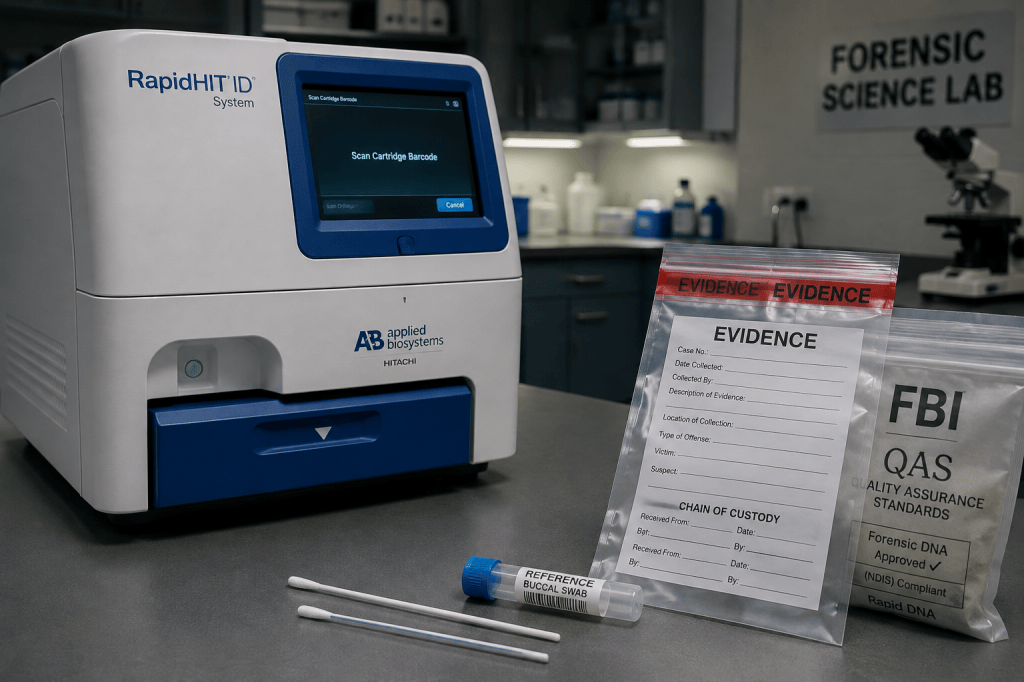
Rapid DNA technology is moving from a specialized forensic concept toward an operational capability with direct consequences for law-enforcement evidence management. The Federal Bureau of Investigation (FBI) defines Rapid DNA as an automated process capable of producing a DNA profile from a reference mouth swab in approximately one to two hours. Historically, the most visible application involved booking-station samples from qualifying arrestees. That model is now expanding into forensic casework involving crime-scene evidence. (Law Enforcement)
The development is particularly significant because, effective July 1, 2025, national Quality Assurance Standards (QAS) and National DNA Index System (NDIS) procedures established a framework under which eligible crime-scene evidence processed through approved Rapid DNA systems may be searched or uploaded to the Combined DNA Index System (CODIS). The FBI’s May 2026 Guide to All Things Rapid DNA confirms that forensic Rapid DNA programs can operate through partnerships between law-enforcement agencies and CODIS laboratories. (Law Enforcement)
Louisiana provides a concrete example. The Louisiana State Police Crime Laboratory reports that it has implemented Modified Rapid DNA Analysis for crime-scene evidence. Under its program, Rapid DNA-generated forensic profiles may be uploaded to CODIS and searched nationally for investigative leads. (Louisiana State Police)
For Property & Evidence professionals, this is not simply a faster laboratory instrument. It potentially changes the evidence lifecycle itself. Evidence traditionally moves through collection, packaging, submission, laboratory analysis, return, storage, and eventual disposition. Rapid DNA introduces the possibility that a biological item can generate a potentially actionable investigative result much earlier in that lifecycle. Consequently, evidence-control systems must account not only for the physical item, but also for the analytical event, the generated DNA data, the original sample, retained material, documentation, quality controls, and the relationship between the Rapid DNA result and any subsequent traditional laboratory examination.
The forensic landscape is increasingly moving toward technologies designed to shorten the time between evidence collection and investigative information. Rapid DNA is one of the clearest examples.
The FBI describes Rapid DNA as a fully automated process capable of developing a DNA profile from a mouth swab in approximately one to two hours without the traditional laboratory workflow or human interpretation and review associated with booking-station Rapid DNA. (Law Enforcement)
The important development for Property & Evidence, however, is not merely the speed of the technology. It is the emergence of forensic Rapid DNA for crime-scene evidence.
The FBI’s current guidance distinguishes booking-station Rapid DNA from forensic Rapid DNA. Beginning July 1, 2025, forensic crime-scene samples can be processed through approved Rapid DNA systems under national quality and operational requirements. A qualifying forensic profile can then be considered for CODIS searching or upload following required laboratory interpretation and review. (Law Enforcement)
This distinction matters because the evidence-management consequences of analyzing an arrestee’s reference sample are different from those associated with consuming or altering a piece of physical evidence recovered from a crime scene.
The central Property & Evidence question is therefore no longer simply:
Where is the evidence?
It increasingly becomes:
- What happened to the evidence?
- What analytical information was generated from it?
- What remains physically available, and
- Can the entire process be reconstructed later?
The Technology Shift From Laboratory Bottleneck to Earlier Investigative Intelligence
Traditional forensic DNA processing generally requires evidence to be collected, preserved, submitted to a laboratory, examined, interpreted, reviewed, and reported. Depending upon jurisdiction and laboratory workload, that process can take substantially longer than the analytical time required by the Rapid DNA instrument itself.
Rapid DNA compresses a portion of that timeline.
The FBI’s May 2026 guidance identifies two major implementation environments: booking-station Rapid DNA for qualifying arrestees and Rapid DNA applied to crime-scene samples as forensic casework. (Law Enforcement)
The second category is the critical development for evidence personnel.
The FBI now recognizes a framework under which law-enforcement agencies can partner with CODIS laboratories to develop forensic Rapid DNA programs outside the traditional laboratory environment. Such programs must operate under the appropriate laboratory accreditation and quality framework. (Law Enforcement)
This does not mean that every crime-scene swab can simply be placed into a machine and immediately searched through CODIS.
The opposite is true: the national framework establishes multiple conditions that must be satisfied before a forensic Rapid DNA result is eligible for CODIS.
Those requirements demonstrate that Rapid DNA is becoming an operational forensic process rather than an informal field-testing shortcut.
The Six-Requirement Framework
According to the FBI, six criteria must be satisfied for a forensic sample processed by a Rapid DNA instrument to be eligible for CODIS search or upload.
The requirements include:
- The Rapid DNA instrument’s location and operation must fall under the ISO 17025 accreditation of a CODIS laboratory.
- The forensic sample must be processed according to the 2025 Forensic Quality Assurance Standards.
- The cartridge or chip must be approved by NDIS for forensic sample use.
- The CODIS laboratory must have validated Modified Rapid DNA Analysis for the particular instrument and cartridge/chip.
- Qualified laboratory personnel must interpret and review the generated forensic data before CODIS searching or uploading.
- The evidence must meet CODIS eligibility requirements, including originating from a crime scene and being attributed to the putative perpetrator. (Law Enforcement)
This framework is important for Property & Evidence because it demonstrates that Rapid DNA does not eliminate the forensic laboratory’s role; it changes where and when parts of the workflow occur.
The laboratory remains responsible for critical functions including validation, interpretation, review, CODIS eligibility, and quality assurance.
The FBI specifically states that failure to meet all six requirements renders Rapid DNA data ineligible for CODIS. (Law Enforcement)
Louisiana: A Working Example
Louisiana is particularly significant because it demonstrates that forensic Rapid DNA is no longer merely a future-facing concept.
The Louisiana State Police Crime Laboratory reports that it has implemented Modified Rapid DNA Analysis for crime-scene evidence. The laboratory describes Modified Rapid DNA as a semi-automated process involving automated extraction, amplification, separation, and detection, followed by manual interpretation and technical review by a trained DNA analyst. (Louisiana State Police)
The Louisiana program permits qualifying crime-scene profiles to potentially be uploaded to CODIS for national searching.
This represents a meaningful distinction from the earlier Rapid DNA booking model.
Louisiana first became nationally notable in 2022 when its crime laboratory received FBI approval for Rapid DNA booking operations. That program used qualifying arrestee samples and searched resulting profiles against CODIS resources, including the DNA Index of Special Concern. (Louisiana State Police)
The state’s subsequent implementation of Modified Rapid DNA for crime-scene evidence demonstrates the progression from:
Rapid DNA as a booking technology to:
Rapid DNA as a forensic evidence-processing technology.
That progression should be closely monitored by Property & Evidence units nationwide.
Why Property & Evidence Should Care
Property & Evidence personnel frequently operate at the point where forensic science meets physical evidence management.
That makes Rapid DNA particularly important.
A conventional evidence lifecycle might resemble:
Collection → Packaging → Submission → Laboratory → Analysis → Return → Storage → Disposition
A Rapid DNA-enabled workflow may increasingly resemble:
Collection → Preservation → Rapid Processing → DNA Profile → Laboratory Review → Potential CODIS Search → Continued Evidence Management → Traditional Analysis/Disposition
The difference is significant.
The physical item does not necessarily cease to matter merely because an investigative DNA result has been generated.
In fact, the opposite may be true.
The rapid result may increase the investigative significance of the physical evidence while simultaneously creating additional documentation and preservation obligations.
The Destructive-Testing Problem
One of the most important Property & Evidence issues is that DNA sampling can consume or alter the available biological evidence.
The National Institute of Justice previously documented problems encountered during a Houston Rapid DNA pilot program. Peter Stout of the Houston Forensic Science Center reported that Rapid DNA testing could destroy the tested sample and emphasized the need for duplicate sampling so that material remained available for conventional laboratory confirmation or future testing. (National Institute of Justice)
The significance of this issue extends beyond Rapid DNA.
Forensic technology evolves.
A biological sample that is sufficient for today’s testing may be even more valuable tomorrow when improved sequencing, mixture interpretation, probabilistic genotyping, or other analytical methods become available.
Therefore, a Property & Evidence policy that treats the rapid result as the endpoint may create a long-term evidentiary problem.
The correct question becomes:
What portion of the original evidence must remain after Rapid DNA processing, and who is responsible for preserving it?
The FBI’s current Rapid DNA guidance reinforces this concern by stating that sufficient sample must remain so that a laboratory can reprocess the sample if the Rapid DNA procedure does not produce a quality DNA profile. (Law Enforcement)
Chain of Custody Becomes More Complicated
Rapid DNA does not remove chain-of-custody requirements.
It potentially adds another layer to them.
A conventional evidence record may document:
- Who collected the evidence?
- When and where it was collected?
- How it was packaged?
- Who received it?
- Where it was stored?
- When it was submitted to the laboratory?
- When it was returned?
- Final disposition
A Rapid DNA workflow potentially requires additional documentation concerning:
- The exact item or sample tested
- The person who collected the biological sample
- Whether the sample was split
- Which portion was subjected to Rapid DNA
- Which portion was retained
- Instrument identification
- Cartridge/chip identification
- Date and time of testing
- Operator identification
- Test status
- Quality-control information
- Generated electronic data
- Laboratory review
- CODIS eligibility determination
- CODIS submission/search activity
- Any subsequent confirmatory testing
- Final disposition of both physical and electronic evidence
The National Institute of Justice describes chain of custody as encompassing collection, preservation, packaging, transportation, storage, and inventory documentation. (National Institute of Justice)
Rapid DNA therefore should be treated as an additional evidentiary event within the chain, not as something occurring outside the evidence record.
Contamination Risk Does Not Disappear Because the Instrument Is Automated
Automation can reduce certain forms of human intervention, but it does not eliminate contamination risk at the crime scene.
The National Institute of Justice has specifically warned that moving forensic testing closer to a chaotic crime scene can increase opportunities for contamination and inappropriate use of results. In its discussion of Rapid DNA, NIJ identified the surrounding operational environment—not simply the instrument—as an important source of risk. (National Institute of Justice)
This is particularly important because DNA evidence can be extremely sensitive to collection practices.
The collection process therefore remains foundational.
Gloves, collection tools, packaging, elimination samples, scene documentation, separation of personnel and evidence, environmental considerations, and contamination controls remain important regardless of how quickly the resulting sample can be analyzed.
The technology may be rapid.
The evidence still has to be collected correctly.
The “Fast Result” Can Create a Documentation Trap
A major operational risk is psychological rather than technological.
When an investigative lead becomes available within hours rather than weeks, personnel may begin treating the Rapid DNA result as the primary evidence rather than as an analytical result generated from physical evidence.
That distinction matters.
A DNA profile is not the physical evidence.
The profile is information derived from the evidence.
The physical evidence may contain additional probative information—including fingerprints, trace evidence, biological material from additional contributors, injury patterns, transfer evidence, or other forensic characteristics—that could be lost if the item is consumed, discarded, repackaged improperly, or prematurely released.
This is why Rapid DNA should not be understood as:
“We got DNA, so we’re done with the item.”
It should instead be understood as:
“We generated an investigative result from this item; now the evidentiary lifecycle continues.”
CODIS Creates a Second Evidence Dimension
CODIS adds another layer to the Property & Evidence equation.
The Louisiana State Police explains that crime-scene DNA profiles can be searched against known profiles and that DNA data can be uploaded to the national CODIS database for comparison with profiles from other jurisdictions. (Louisiana State Police)
Consequently, a single physical item may now generate multiple connected records:
Physical Evidence
↓
Biological Sample
↓
Rapid DNA Analytical Data
↓
Reviewed DNA Profile
↓
CODIS Eligibility Determination
↓
CODIS Search/Upload
↓
Investigative Lead
Each layer may have different retention, access, audit, disclosure, security, and disposition considerations.
This is precisely why evidence-management professionals need to be included in Rapid DNA implementation discussions from the beginning.
The FBI Is Explicitly Calling for Evidence-Control Involvement
The FBI’s 2025 guidance for agencies implementing forensic Rapid DNA programs is particularly revealing from a Property & Evidence perspective.
The FBI recommends that agencies establish a multidisciplinary Rapid DNA task force before executing a memorandum of understanding with the CODIS laboratory.
The identified stakeholders include laboratory management, quality assurance personnel, CODIS administrators, technical leaders, IT personnel, and—critically for this report—evidence control and crime-scene response personnel. (Law Enforcement)
The FBI further identifies training, documentation requirements, secure data transfer, sample acceptance, equipment maintenance, funding, and defined responsibilities as implementation considerations. (Law Enforcement)
This is a strong indication that Rapid DNA implementation is not solely a laboratory purchasing decision.
It is an evidence-management system decision.
What Property & Evidence Policies Should Begin Asking
Before an agency implements Rapid DNA—or accepts evidence from an agency using it—Property & Evidence leadership should be asking at least the following questions.
- Is Rapid DNA collection changing existing biological-evidence collection procedures?
- Are duplicate samples required?
- Who determines which sample is tested?
- Who determines which sample is retained?
- Are elimination samples documented?
Packaging and Preservation
- Does Rapid DNA processing require different packaging?
- How is unused biological material preserved?
- Does the process change drying requirements?
- How are wet biological items handled?
- What happens to the cartridge/chip after testing?
Chain of Custody
- Is the Rapid DNA testing event incorporated into the agency’s chain-of-custody record?
- Can the agency identify exactly which physical sample generated the profile?
- Is the operator recorded?
- Is instrument identification recorded?
- Are date and time automatically captured?
Electronic Evidence
- Where is the raw Rapid DNA data stored?
- Who owns the data?
- Who can access it?
- How is it backed up?
- Is it subject to discovery?
- How long is it retained?
- Can it be produced in a usable format years later?
CODIS
- Who determines CODIS eligibility?
- Who authorizes the search/upload?
- Who receives the hit?
- How is the CODIS activity documented in the case file?
- What happens if the profile is later determined to be unsuitable?
- What happens to the physical evidence if the CODIS search produces a lead?
Disposition
- Does a CODIS hit change the retention period?
- Does Rapid DNA testing change the legal status of the evidence?
- Can the item be destroyed after testing?
- Who authorizes destruction?
- What happens when a case is adjudicated?
- Are DNA-derived records subject to separate retention requirements?
The Larger Property & Evidence Transformation
Rapid DNA illustrates a broader transformation occurring throughout forensic evidence management.
Technology is increasingly turning physical evidence into multiple evidence objects.
A single piece of evidence may now produce:
- A physical evidence item.
- A biological sample.
- Digital photographs.
- Scan or imaging data.
- Analytical instrument data.
- A forensic profile.
- Database records.
- Search results.
- Laboratory reports.
- Investigative leads.
- Court-discoverable documentation.
Property & Evidence systems that are designed primarily around physical inventory may eventually need to become more sophisticated evidence-information systems.
The question is no longer only:
“Do we still have the gun, shirt, swab, phone, vehicle, or package?”
It becomes:
“Can we reconstruct everything that happened to that item and every evidentiary derivative created from it?”
Rapid DNA is an early and particularly clear example of this transition.
Professional Assessment
The FBI’s current framework confirms that forensic Rapid DNA is no longer limited to conceptual research or booking-station applications. National requirements now exist for eligible crime-scene evidence. (Law Enforcement)
The Louisiana State Police Crime Laboratory reports active Modified Rapid DNA Analysis of crime-scene evidence and the possibility of CODIS upload and national searching. (Louisiana State Police)
Forensic Rapid DNA profiles require qualified laboratory interpretation and review before CODIS search or upload. (Law Enforcement)
Rapid DNA can create a result quickly, but the physical sample may be consumed or altered. Existing forensic experience demonstrates the importance of retaining material for confirmation and future testing. (National Institute of Justice)
Finding 5: Property & Evidence should be involved before implementation.
The FBI specifically identifies evidence-control personnel among the stakeholders who should participate in forensic Rapid DNA program development. (Law Enforcement)
Finding 6: Rapid DNA should be treated as an evidence-lifecycle change.
The technology changes the timing, location, documentation, preservation, and information generated from biological evidence. It should therefore be incorporated into evidence policy, SOPs, training, audit procedures, records management, and disposition planning.
Rapid DNA should be considered a Property & Evidence trend, not merely a forensic technology trend.
The most important development is not the claim that a DNA profile can be produced in approximately 90 minutes or one to two hours. The significant development is that the forensic ecosystem is establishing mechanisms by which qualifying crime-scene evidence can be processed through Rapid DNA systems, reviewed under laboratory quality standards, and potentially searched through CODIS.
Louisiana provides an operational example of this emerging model, while the FBI’s 2025–2026 guidance provides the national framework. (Louisiana State Police)
For Property & Evidence professionals, the implications are substantial.
The evidence lifecycle is becoming faster—but also more complicated.
The agency must preserve not merely the item, but the history of what happened to the item.
As forensic technology moves closer to the crime scene, the Property & Evidence function becomes increasingly important as the system responsible for ensuring that speed does not come at the expense of integrity.
The emerging standard should therefore be:
Collect carefully. Process intelligently. Document completely. Preserve what remains. Track every derivative. And never confuse a fast investigative result with the end of the evidence lifecycle.
References
Federal Bureau of Investigation. (2025, February 26). Considerations for law enforcement agencies implementing forensic (crime scene evidence) Rapid DNA programs with CODIS agencies. U.S. Department of Justice. (Law Enforcement)
Federal Bureau of Investigation. (2026, May 1). Guide to all things Rapid DNA (Version 3.0). U.S. Department of Justice. (Law Enforcement)
Federal Bureau of Investigation. (n.d.). Rapid DNA. U.S. Department of Justice. (Law Enforcement)
Louisiana State Police. (n.d.). CODIS DNA Unit. Louisiana Department of Public Safety and Corrections. (Louisiana State Police)
Louisiana State Police. (n.d.). Rapid DNA Program. Louisiana Department of Public Safety and Corrections. (Louisiana State Police)
Louisiana State Police. (n.d.). Evidence Receiving Unit. Louisiana Department of Public Safety and Corrections. (Louisiana State Police)
National Institute of Justice. (2021, January 5). Caution is necessary when expanding field testing capabilities. U.S. Department of Justice. (National Institute of Justice)
National Institute of Justice. (2023). Collecting DNA evidence at property crime scenes: Chain of custody. U.S. Department of Justice. (National Institute of Justice)
 The Gilded Margin
Leave a comment