National Forensic Science Week | The Gilded Margin
When most people hear “crime lab,” I think their minds probably go straight to DNA.
Maybe fingerprints.
Maybe someone in a white coat staring through a microscope while dramatic music plays in the background.
But a state crime laboratory is doing a whole lot more than that.
I wanted to look at the numbers Texas Department of Public Safety released for National Forensic Science Week because they give a pretty good idea of just how much work happens behind the scenes.
And honestly, some of these numbers are kind of wild.
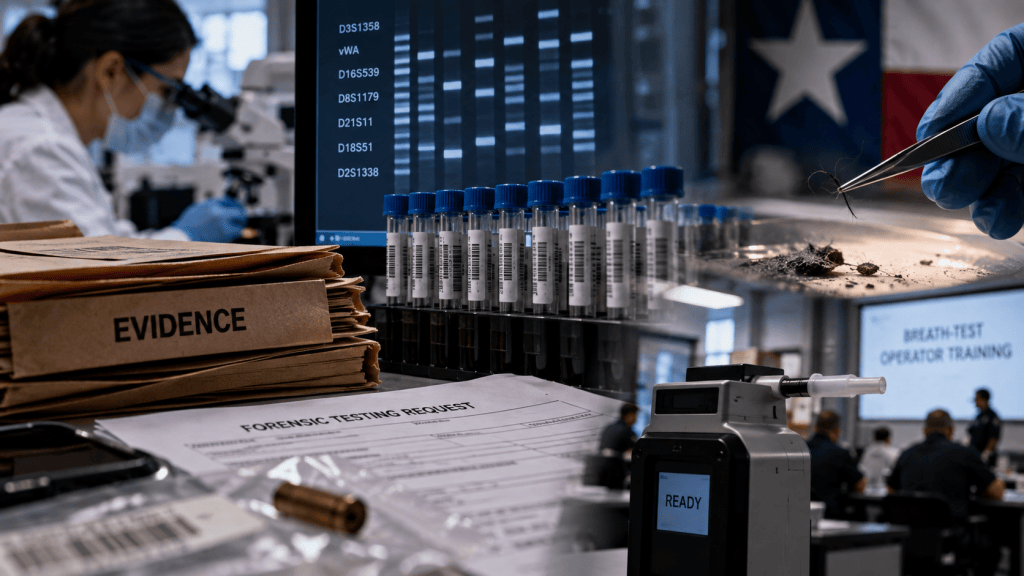
During the past year, the Texas DPS Crime Laboratory Division reported processing 113,259 requests for forensic testing.
They also uploaded a record 148,993 arrestee and offender DNA samples to CODIS.
The Breath Alcohol Program held 64 breath-test operator schools and certified approximately 1,200 new breath-test operators.
Those are just the numbers DPS highlighted.
So what does all of that actually mean?
113,259 forensic-testing requests
Let’s start with the biggest number.
113,259.
That’s not 113,259 DNA tests.
That’s 113,259 requests for forensic testing across multiple disciplines.
Texas DPS’s Crime Laboratory Division handles areas including biology and DNA, firearms and toolmarks, friction ridge analysis, toxicology, seized drugs, trace evidence, forensic documents, and digital and multimedia evidence (Texas Department of Public Safety [TxDPS], 2026).
Trace evidence alone can involve things like hair, fibers, paint, glass, gunshot primer residue, impressions, and ignitable liquid residue.
So when someone says, “The evidence was sent to the crime lab,” that doesn’t really tell us much.
What kind of evidence?
What question needs to be answered?
What type of examination is appropriate?
Those questions determine which forensic discipline gets involved.
And that is one of the things I think gets lost when forensic science is reduced to television.
There isn’t one giant forensic test that you run on everything.
Different evidence requires different scientific approaches.
A firearm isn’t examined the same way as a bloodstain.
A fingerprint isn’t examined the same way as a suspected drug.
A piece of glass isn’t examined the same way as a phone.
The evidence determines the science.
Texas DPS’s Crime Laboratory Division has grown considerably since it began in 1937 as a one-chemist operation in Austin. Today, DPS describes it as a statewide forensic laboratory system with 16 accredited laboratories and programs and approximately 712 personnel (TxDPS, 2026). (Texas Department of Public Safety)
That’s a pretty significant evolution from one chemist.
148,993 DNA samples and CODIS
Then there’s DNA.
Texas DPS reported uploading 148,993 arrestee and offender DNA samples to CODIS during the past year. That was a record number for the department (TxDPS, 2026). (Texas Department of Public Safety)
CODIS is the Combined DNA Index for a System, which allows qualifying DNA profiles to be entered into databases and compared with other profiles.
And this is where I think the distinction between a DNA sample and a DNA profile matters.
A forensic DNA laboratory isn’t simply putting someone’s biological material into a giant database.
The laboratory develops a DNA profile that can be used for comparison.
That information can then become part of a much larger system.
Sometimes the significance of a profile isn’t immediately obvious.
A comparison made today might become more meaningful when another profile is entered tomorrow.
That is one of the reasons forensic databases are so important. They allow information to be compared across cases and over time.
But there is also an important limitation here.
A DNA association does not automatically tell investigators the entire story of an event.
Finding someone’s DNA somewhere doesn’t, by itself, explain exactly when it was deposited, how it got there, or what happened.
Context still matters.
That’s something forensic science has to deal with constantly.
The evidence can give us information.
The science helps us interpret that information.
But neither one should be stretched beyond what it can actually support.
64 breath-test operator schools
Here’s another part of the DPS Crime Laboratory system that people may not immediately think of when they hear “forensics.”
Breath alcohol testing.
During the past year, the DPS Breath Alcohol Program conducted 64 breath-test operator schools and certified approximately 1,200 new operators (TxDPS, 2026). (Texas Department of Public Safety)
That is forensic science, too.
There is training.
There are standardized procedures.
There are quality requirements.
There is scientific oversight.
There is equipment that has to be maintained and evaluated.
And there are people who have to be trained to properly operate that equipment.
It’s easy to look at a breath-testing instrument and think the machine is doing all the work.
It isn’t.
The instrument is one part of a larger forensic system.
The people operating it, the procedures they follow, the quality systems surrounding the program, and the scientific oversight all matter.
So what does a state crime lab actually do?
A lot.
And that’s probably the simplest answer.
A state crime laboratory takes physical evidence and applies specialized scientific methods to questions that arise during criminal investigations and legal proceedings.
That can mean DNA.
Fingerprints.
Firearms.
Drugs.
Toxicology.
Digital evidence.
Trace evidence.
Documents.
And more.
It can also mean maintaining statewide forensic programs, training personnel, supporting investigative agencies, maintaining databases, providing technical expertise, and eventually explaining scientific findings in court.
The laboratory isn’t operating in isolation.
It is one part of a much larger system.
Evidence has to be collected properly.
It has to be preserved.
It has to be documented.
It has to be examined using an appropriate method.
The results have to be interpreted.
And the work has to be documented well enough that someone else can understand what was done and why.
That’s a lot of responsibility sitting behind what can sometimes look like a very simple laboratory result.
The part nobody sees
This is probably my favorite part of forensic science.
The stuff that doesn’t make good television.
Quality assurance.
Controls.
Calibration.
Validation.
Training.
Documentation.
Technical review.
Understanding limitations.
Doing the same careful process over and over again because consistency matters.
Real forensic science is rarely a dramatic race against the clock.
It is usually much more methodical.
And that’s a good thing.
Because when evidence is being used to help answer questions in a criminal investigation, “close enough” isn’t really good enough.
The goal isn’t to make the evidence fit a theory.
The goal is to determine what the evidence can actually tell us.
Sometimes that’s a lot.
Sometimes it’s surprisingly little.
Sometimes the evidence answers the question.
Sometimes it creates another question.
And sometimes the scientifically appropriate conclusion is that there simply isn’t enough information to say more.
That is still a result.
One year of forensic science in Texas
When I put the DPS numbers together, the scale starts to make a little more sense.
113,259 requests for forensic testing.
148,993 arrestee and offender DNA samples uploaded to CODIS.
64 breath-test operator schools.
Approximately 1,200 newly certified breath-test operators.
And behind those numbers are hundreds of people working across a statewide forensic laboratory system.
That’s what I wanted to highlight for National Forensic Science Week.
Forensic science isn’t one test.
It isn’t one machine.
It isn’t one person in a lab.
And it definitely isn’t the version we see on television.
It is a collection of scientific disciplines working together with the criminal justice system to answer questions about evidence.
Sometimes the answer is complicated.
Sometimes it’s straightforward.
Sometimes the evidence doesn’t give us the answer at all.
But every time, the starting point is the same:
What does the science actually support?
That’s the part of forensics that interests me the most.
Because behind every number is a piece of evidence, a scientific method, a person doing the examination, and a question that somebody needs answered.
And that’s a lot more interesting than television ever gives it credit for.
Forensics is where science meets evidence.
References
Texas Department of Public Safety. (2026, September 21). DPS honors Crime Laboratory during National Forensic Science Week. https://www.dps.texas.gov/news/dps-honors-crime-laboratory-during-national-forensic-science-week-0
Texas Department of Public Safety. (n.d.). Crime Laboratory Division. https://www.dps.texas.gov/section/crime-laboratory


Leave a comment