National Forensic Science Week | Gilded Margin Forensics
Forensic science is usually talked about in terms of evidence.
DNA.
Fingerprints.
Firearms.
Drugs.
Toxicology.
Fibers.
Glass.
Digital evidence.
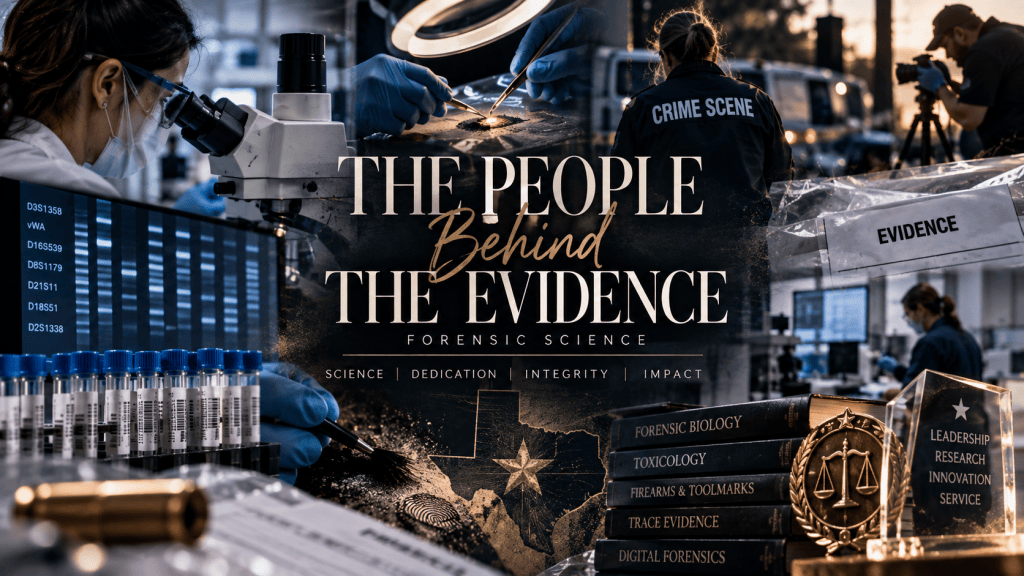
But none of that happens without people.
This week I’ve been looking at what actually happens inside forensic laboratories, including the numbers Texas Department of Public Safety released for National Forensic Science Week.
During the past year, the Texas DPS Crime Laboratory Division processed 113,259 requests for forensic testing and uploaded a record 148,993 arrestee and offender DNA samples to CODIS. The department also conducted 64 breath-test operator schools and certified approximately 1,200 new operators (Texas Department of Public Safety [TxDPS], 2026).
Those numbers are impressive.
But what interests me more is the number of people behind them.
There are forensic scientists examining evidence.
Laboratory managers keeping systems running.
Quality assurance professionals making sure procedures are followed.
Crime scene personnel documenting and collecting evidence.
Technicians maintaining equipment and processing submissions.
Researchers developing new methods.
Educators training the next generation.
And people working in specialties that most of the public probably never even realizes exist.
Forensic science is a field where the smallest detail can matter.
That means the people doing the work have to care about details, too.
They have to know their methods.
They have to understand the limitations of their discipline.
They have to document what they do.
They have to be willing to question results.
And sometimes they have to say, “We don’t have enough information to answer that.”
That last part is important.
The job isn’t to produce the answer everyone wants.
The job is to produce the answer the science supports.
That requires a level of professional responsibility that deserves recognition.
Recognizing some of the people advancing the field
National Forensic Science Week is also a good opportunity to recognize professionals who have made significant contributions to forensic science.
This year, Jeremy Triplett received the American Society of Crime Laboratory Directors’ Briggs J. White Award for Excellence through Leadership in Forensic Science Management. The award recognizes leadership and managerial excellence within forensic science. Triplett has served in forensic laboratory leadership and previously served as ASCLD president (American Society of Crime Laboratory Directors [ASCLD], 2026). (ASCLD)
Edward Sisco of the National Institute of Standards and Technology received the 2026 ASCLD Forensic Research Committee Innovation Award for research involving ambient ionization mass spectrometry interlaboratory studies. The award recognizes research that contributes to new technologies, protocols, or tools that can affect forensic laboratory practice (National Institute of Standards and Technology [NIST], 2026). (NIST)
And Tara Martinez of Idaho State Police Forensic Services was named the 2026 recipient of the Rick Groff Visionary Leadership in Forensic Science Award. Her work has included latent print examination, crime scene response, training, competency development, validation work, and leadership within the agency’s crime scene discipline (Idaho State Police, 2026). (Idaho State Police)
I wanted to mention these people because awards like these are a reminder that forensic science isn’t only about the newest instrument or the most interesting case.
Leadership matters.
Research matters.
Training matters.
Quality matters.
And the people willing to do those things well matter.
But recognition shouldn’t stop with the people whose names happen to appear on an award.
There are thousands of forensic professionals doing this work every day.
Some are working in large state laboratories.
Some are in local laboratories.
Some are in medical examiner and coroner offices.
Some are at crime scenes.
Some are teaching.
Some are developing standards and methods.
Some are working behind the scenes keeping laboratories accredited, organized, and operational.
Most of their work will never make the news.
Most of their names will never be known outside their profession.
That doesn’t make the work any less important.
So today, during National Forensic Science Week, I want to say thank you.
Thank you to the scientists who examine the evidence.
Thank you to the technicians who process it.
Thank you to the people who collect it.
Thank you to the quality professionals who question it.
Thank you to the researchers who keep pushing the science forward.
Thank you to the educators who teach the next generation.
And thank you to the laboratory leaders who understand that a credible forensic system depends on much more than getting results.
It depends on getting them right.
Congratulations to this year’s award recipients, and congratulations to every forensic professional who continues to show up, do the work, and take the science seriously.
You may not always be the part of the investigation that people see.
But you are part of the reason the evidence can be trusted.
Forensics is where science meets evidence.
References
American Society of Crime Laboratory Directors. (2026). Our history and awards. https://www.ascld.org/our-history/
Idaho State Police. (2026). National Forensic Science Week. https://isp.idaho.gov/forensics/nfsw/
National Institute of Standards and Technology. (2026, May 28). Ed Sisco receives 2026 ASCLD FRC Innovation Award. https://www.nist.gov/awards/ed-sisco-receives-2026-ascld-frc-innovation-award
Texas Department of Public Safety. (2026, September 21). DPS honors Crime Laboratory during National Forensic Science Week. https://www.dps.texas.gov/news/dps-honors-crime-laboratory-during-national-forensic-science-week-0


Leave a comment