Investigation| Gilded Margin
There is a difference between finding one bad forensic case and realizing you might be looking at a pattern.
That difference is where an investigation gets interesting.
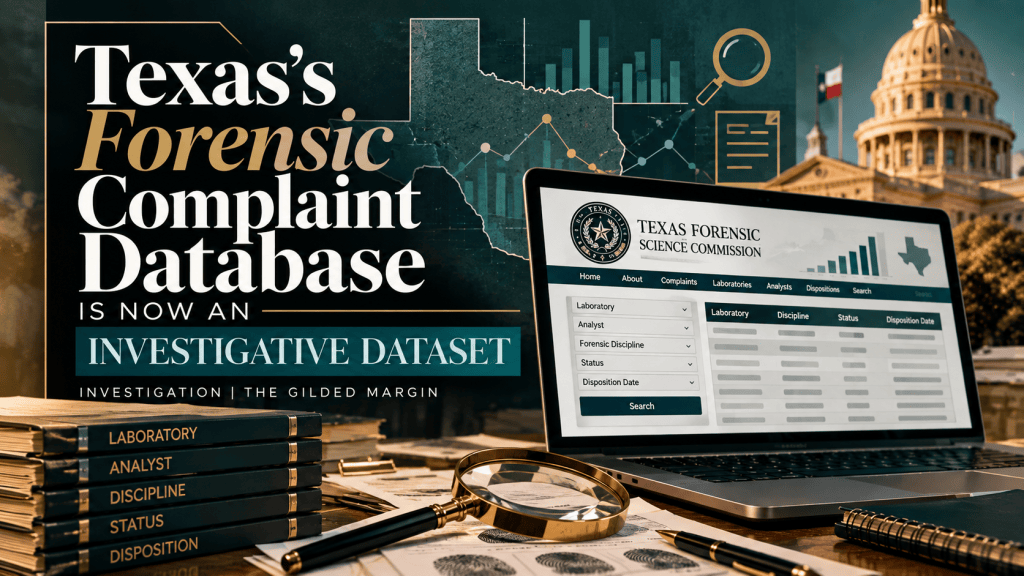
I kept thinking about that while looking through the Texas Forensic Science Commission’s public complaint system. It is searchable by laboratory or analyst, forensic discipline, status, and disposition date. On the surface, it looks like a place to look up individual complaints.
But it can be used for something much bigger.
It can be treated as a dataset.
And that changes the questions we can ask.
Instead of starting with one dramatic complaint and trying to build a story around it, we can start with the records themselves and see what they tell us.
What kinds of complaints are showing up?
Are the same problems happening more than once?
Are certain issues showing up more often in particular forensic disciplines?
How long does it take for complaints to be resolved?
What happens after a problem is identified?
And, perhaps most importantly, did the problem actually affect the forensic result or the case?
That’s a much more interesting investigation than simply counting complaints.
A complaint is not the same thing as a finding
This is where I would slow down before drawing any conclusions.
A complaint is not automatically proof that a laboratory did something wrong.
The Texas Forensic Science Commission investigates allegations involving professional negligence and professional misconduct in certain circumstances. The Commission’s definitions focus on whether a failure to follow applicable standards substantially affected the integrity of forensic-analysis results.
So if we’re going to use the complaint records as investigative data, we have to keep the stages separate.
Someone made a complaint.
The complaint was reviewed.
Maybe it was investigated.
Maybe it was dismissed or closed without further action.
Maybe additional information was requested.
Maybe corrective action was required.
Maybe the issue was substantiated.
Those are not all the same thing.
And an investigation that treats every complaint as a confirmed laboratory failure would be misleading from the beginning.
I wouldn’t rank the laboratories
This is probably the biggest trap in the entire project.
Imagine creating a spreadsheet and discovering that one laboratory has 40 complaints while another has 10.
It would be very easy to write:
Laboratory A has four times as many complaints as Laboratory B.
But what does that actually tell us?
Not nearly enough.
A laboratory may have more complaints because it is larger. It may process substantially more cases. It may have more analysts. It may have a stronger culture of internal reporting. It may identify and disclose problems that another laboratory never reports publicly.
In fact, the Commission’s quality-incident materials make an important point about this. A laboratory that identifies and documents quality problems isn’t necessarily a poorly functioning laboratory. A robust quality-assurance system can actually be a sign that a laboratory is doing what it is supposed to do—finding problems and correcting them.
So I don’t want a leaderboard.
I want context.
Here’s where the data could become useful
I’d build the basic record something like this:
Lab → Discipline → Complaint → Date → Finding → Corrective action → Case impact
That sounds simple.
It isn’t.
Because once you start filling in those columns, you have to read the underlying records.
Suppose there are several complaints involving documentation.
At first glance, that could look like a recurring problem.
But maybe some were minor administrative errors that had no effect on the forensic work.
Maybe another involved an actual reporting problem.
Maybe one resulted in an amended report.
Maybe one caused the laboratory to review additional cases.
Those shouldn’t all be lumped together.
The number of complaints tells us that something was reported.
The documents tell us what actually happened.
That’s where the investigation lives.
I would look for patterns before I looked for names
The first thing I’d want to know is whether certain problems keep appearing.
Maybe there are repeated issues involving documentation.
Maybe evidence handling comes up repeatedly.
Maybe certain problems involve interpretation rather than the underlying testing.
Maybe one discipline has a completely different pattern than another.
And that matters because forensic science isn’t one thing.
DNA testing isn’t the same as toxicology.
Toxicology isn’t the same as seized-drug analysis.
Firearms and toolmarks aren’t the same as forensic biology.
The problems we should expect—and the consequences when something goes wrong—can be very different.
So instead of asking, “Which lab is the worst?” I’d rather ask:
What problems keep showing up, and where?
That question could actually teach us something.
Then I’d look at the clock
The dates could tell another story.
When was the complaint filed?
When did the Commission receive it?
When was it investigated?
When was it resolved?
How long did the process take?
The Commission’s process allows matters to be tabled when additional information is needed, so a longer timeline isn’t automatically evidence that something went wrong.
But that doesn’t mean the timeline isn’t worth examining.
If certain types of complaints consistently take much longer to resolve, I’d want to know why.
If a complaint sits for months and then closes quickly, I’d want to understand what happened during that period.
And if a problem is identified quickly but corrective action takes much longer, that’s another piece of the story.
Sometimes the timeline tells you what the complaint description doesn’t.
But the corrective action may be the most important part
This is the part I’d really want to dig into.
Finding a problem is one thing.
What did the laboratory do about it?
Was an analyst retrained?
Was a procedure changed?
Was a piece of equipment replaced?
Were other cases reviewed?
Was an outside review conducted?
Was a report corrected?
Was the issue determined to have no effect on the reported result?
Those answers tell us whether we’re looking at an isolated mistake, a quality-control issue, or something that potentially reaches much further.
And sometimes the corrective action itself can reveal how seriously the problem was taken.
That’s why I wouldn’t stop at the complaint record.
I’d follow the paperwork.
Then comes the question that really matters
Did anybody’s case change because of this?
That’s the question that moves this from an interesting government database to something with real public impact.
A paperwork error is not necessarily the same as an incorrect forensic result.
A mislabeled document isn’t automatically the same thing as contaminated evidence.
A procedural violation isn’t automatically proof that a reported result was wrong.
And the Commission’s quality-incident materials recognize that incidents can range from relatively minor problems to significant issues, with different consequences and corrective responses.
So I’d want a separate field for case impact.
No impact.
Potential impact.
Confirmed impact.
Unknown.
And then I’d want to read the records closely enough to know why.
Because that’s the part that matters to everyone outside the laboratory.
If forensic evidence was used in a criminal case, did the problem change the evidence?
Did it change the report?
Did prosecutors have to be notified?
Did defense counsel receive additional information?
Was the case reviewed?
Was a conviction affected?
Those are much bigger questions than how many complaints a laboratory has.
There may be an even bigger dataset hiding nearby
The complaint database shouldn’t necessarily be the end of the investigation.
The Texas Forensic Science Commission also maintains public information involving quality incidents and self-disclosures. Its Quality Incident Library is intended to provide a centralized public resource for quality incidents and corrective-action information from participating Texas-accredited laboratories.
That creates an interesting possibility.
Instead of looking at complaints alone, you could eventually compare three different streams:
Complaints.
Self-disclosures.
Quality incidents.
Those aren’t interchangeable either.
But together, they could tell us something about how problems are discovered.
Was someone outside the laboratory complaining?
Did the laboratory discover the issue itself?
Did another quality-control process catch it?
Was the problem identified during an audit?
That distinction could be incredibly important.
Because sometimes finding the problem is actually the good news
This is the part that makes me hesitant to ever turn this into a simple “bad laboratories” story.
Imagine two laboratories.
Laboratory A has very few documented problems.
Laboratory B has considerably more.
At first glance, Laboratory A looks better.
But what if Laboratory B has an aggressive internal quality program, encourages employees to report mistakes, reviews cases when something goes wrong, documents corrective action, and publicly discloses incidents?
And what if Laboratory A simply doesn’t have the same level of reporting?
We wouldn’t know which laboratory is safer by looking at the complaint count.
We’d have to look at how the system responds to problems.
That’s a much harder investigation.
It’s also a much fairer one.
The real story is probably in the repetition
One complaint can be an accident.
Two similar complaints might be coincidence.
But when you start seeing the same type of problem repeatedly, across different records, that’s when I want to start asking questions.
Is there a training issue?
A policy issue?
A staffing issue?
A technology issue?
A particular methodology that creates recurring challenges?
Are different laboratories making the same mistake?
If so, maybe the problem isn’t one laboratory at all.
Maybe there’s a broader issue within a discipline.
And that is exactly why I think this database is worth treating as investigative data rather than just a collection of government records.
The records give us the opportunity to step back.
Instead of asking, What happened here?
We can ask:
What keeps happening?
That’s the story I’d want to tell
Not “these labs had the most complaints.”
Not “Texas forensic laboratories are failing.”
And definitely not a sensationalized list of individual cases without context.
I’d want to know what the records show about errors, how often they occur, what kinds of problems repeat, how quickly they are addressed, what corrective action looks like, and whether the problems ever affect the forensic results that make their way into courtrooms.
Because mistakes happen.
The important question is what happens after the mistake.
Does somebody catch it?
Does the laboratory own it?
Does the Commission investigate it?
Does the laboratory correct it?
Does anyone go back and look at other cases?
Does the system tell the people who need to know?
And, ultimately:
Did it matter?
That’s the difference between counting complaints and investigating them.
The database gives us the first part.
The real work is finding the pattern.
References
Texas Forensic Science Commission. (2026). Complaints. Texas Forensic Science Commission. Texas Forensic Science Commission complaint database
Texas Forensic Science Commission. (2026). Complaints: Overview. Texas Forensic Science Commission. Texas Forensic Science Commission complaint information
Texas Forensic Science Commission. (2026). Quality incident public database: Overview. Texas Forensic Science Commission. Texas Forensic Science Commission Quality Incident Library


Leave a comment