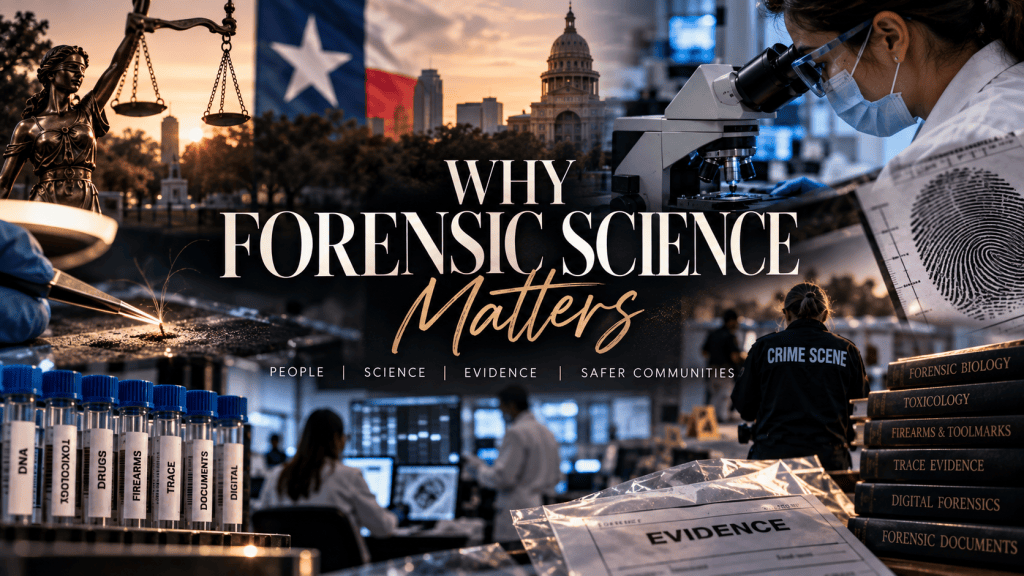
National Forensic Science Week | Gilded Margin Forensics
There is a reason I wanted to spend this week talking about forensic science.
It is easy to focus on the evidence.
The fingerprint.
The DNA profile.
The firearm.
The toxicology result.
The tiny fiber.
The digital file.
The thing recovered from a crime scene that eventually makes its way into a laboratory.
But forensic science is bigger than the evidence itself.
It is about what happens when we take something physical and ask a scientific question about it.
What is this?
Where might it have come from?
Can it be compared?
Is there enough information to reach a conclusion?
What does this result actually mean?
And just as importantly:
What doesn’t it mean?
That last question is one of the things I appreciate most about forensic science.
There is a temptation, especially in true crime and television, to treat forensic evidence like it is capable of answering everything.
It isn’t.
Science has limitations.
Evidence has limitations.
Methods have limitations.
People have limitations.
Understanding those limitations doesn’t make forensic science less valuable.
It makes the work more honest.
This week, Texas DPS gave us a pretty incredible reminder of just how much forensic work is happening in one state.
Its Crime Laboratory Division processed 113,259 requests for forensic testing during the past year. It uploaded a record 148,993 arrestee and offender DNA samples to CODIS, conducted 64 breath-test operator schools, and certified approximately 1,200 new operators (TxDPS, 2026). (Texas Department of Public Safety)
And that is only one state laboratory system.
Across the country, forensic professionals are doing this work every day.
They are examining evidence from current investigations.
They are working older cases.
They are researching better methods.
They are developing standards.
They are training.
They are maintaining equipment.
They are reviewing results.
They are testifying.
They are answering questions.
And sometimes, they are telling investigators something they probably didn’t want to hear.
That the evidence doesn’t support the theory.
That the sample isn’t sufficient.
That the result is inconclusive.
That more work is needed.
That is part of the job, too.
Forensic science doesn’t exist to make a story more convincing.
It exists to evaluate evidence scientifically.
That distinction matters.
A week worth recognizing
National Forensic Science Week is an opportunity to recognize the people working throughout this field and to remind the public that forensic science involves far more than what we see on television.
The Consortium of Forensic Science Organizations describes the week as an opportunity to recognize scientists, technicians, medical examiners, coroners, crime scene investigators, and other professionals whose work supports investigations, judicial proceedings, and public safety (Consortium of Forensic Science Organizations [CFSO], 2026). (The CFO Society)
I think that list is important.
Because when we say “forensic scientist,” we can accidentally make the field sound much smaller than it actually is.
There are so many disciplines.
So many specialties.
So many different paths into this work.
And so many people who contribute to the final result without ever being the person whose name appears on the report.
This year’s award recipients are another reminder of that range.
Jeremy Triplett was recognized for leadership in forensic science management.
Edward Sisco was recognized for forensic research and innovation.
Tara Martinez was recognized for visionary leadership and her contributions to training, crime scene work, latent prints, and laboratory operations. (ASCLD)
Congratulations to each of them.
And congratulations to the people whose names we don’t know.
The person working the late shift.
The analyst reviewing another case.
The technician carefully documenting evidence.
The scientist validating a method.
The quality manager catching something before it becomes a problem.
The instructor teaching someone who is just starting out.
The researcher working on something that may eventually change how evidence is examined.
Those people matter, too.
So, what is forensic science?
It is biology.
It is chemistry.
It is physics.
It is statistics.
It is technology.
It is observation.
It is documentation.
It is research.
It is quality assurance.
It is critical thinking.
And, maybe most importantly, it is knowing when the evidence has reached its limit.
Forensic science doesn’t always give us a perfect answer.
But when it is done carefully, transparently, and scientifically, it gives us something incredibly important: information we can evaluate.
That is worth protecting.
That is worth improving.
And that is worth celebrating.
So as National Forensic Science Week comes to a close, this is my thank-you to the people behind the science.
To the scientists.
The technicians.
The investigators.
The researchers.
The educators.
The laboratory leaders.
The quality professionals.
The crime scene personnel.
The medical examiners and coroners.
And everyone else whose work helps turn evidence into scientifically meaningful information.
Thank you for doing the work that most people never see.
Congratulations to this year’s award recipients.
And to everyone working in forensic science: I hope you know that your work matters.
Forensics is where science meets evidence.
References
Consortium of Forensic Science Organizations. (2026, September 21). National Forensic Science Week. https://thecfso.org/news/2026/09/national-forensic-science-week/
Idaho State Police. (2026). National Forensic Science Week. https://isp.idaho.gov/forensics/nfsw/
National Institute of Standards and Technology. (2026, May 28). Ed Sisco receives 2026 ASCLD FRC Innovation Award. https://www.nist.gov/awards/ed-sisco-receives-2026-ascld-frc-innovation-award
Texas Department of Public Safety. (2026, September 21). DPS honors Crime Laboratory during National Forensic Science Week. https://www.dps.texas.gov/news/dps-honors-crime-laboratory-during-national-forensic-science-week-0


Leave a comment