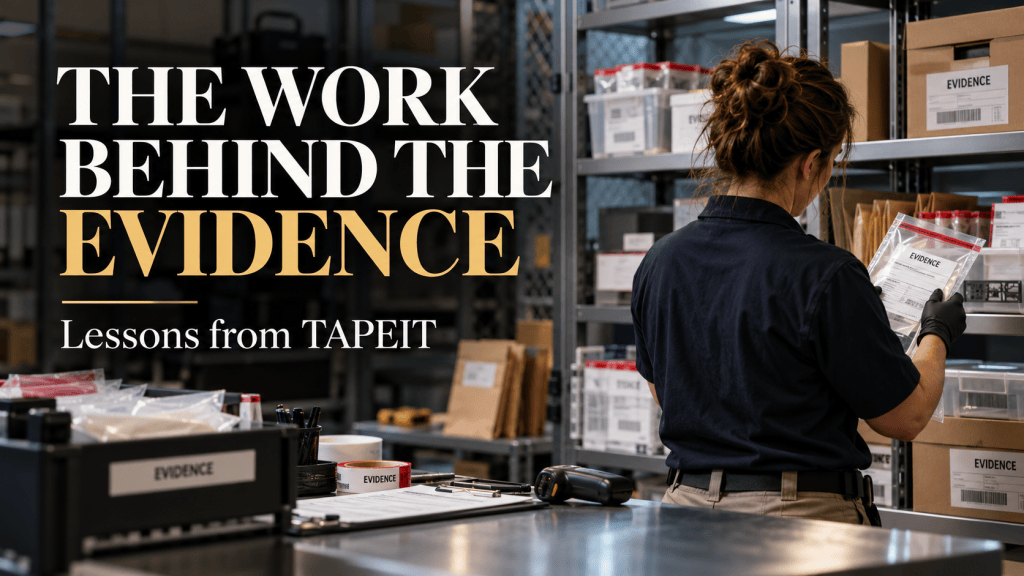
The Gilded Margin|Property and Evidence
Beyond the evidence room: professional growth, collaboration, resilience, and the people who help uphold the integrity of justice.
There is a side of the justice system that rarely makes headlines, rarely appears in television crime dramas, and is often misunderstood by people outside the profession. It is the work that happens after evidence is collected, when accountability, organization, legal requirements, and careful decisions become just as important as the investigation itself.
This week, I’m attending the annual conference of the Texas Association of Property and Evidence Inventory Technicians (TAPEIT) in San Marcos, Texas. As an Intermediate Level member, I came into this year’s conference with a particular goal: to choose learning opportunities that would challenge me, strengthen areas where I want to grow, and help prepare me for the next stage of my professional development.
I wanted more than a few days away from the office. I wanted to return with new perspectives, better questions, practical knowledge, and a clearer understanding of how I can continue improving the work I do.
So far, this conference has delivered something even more meaningful than a training schedule. It has reminded me why this profession matters, how much there is still to learn, and why the people doing this work need one another.
A Perspective on 9/11 I Had Never Experienced Before
We began the week with three keynote speakers: Tim Brown of the New York City Fire Department (FDNY), James Luongo of the New York City Police Department (NYPD), and Nicole Martin of the Texas Rangers Cold Case Division.
The first two speakers shared their perspectives as first responders who survived September 11, 2001. I have heard the phone calls to loved ones from people trapped in the buildings and on the planes. I have seen photographs, documentaries, and countless hours of footage. I thought I understood a great deal about that day.
But I had never encountered the experience through this particular perspective.
Hearing from people who were there, who served alongside others, and who lived through the aftermath offered a different understanding of the human cost. The loss was not confined to civilians. It extended deeply into the ranks of the people who ran toward danger to help others.
It was heartbreaking to consider the scale of that loss through the eyes of surviving first responders.
What also stayed with me was learning about the evidence-management challenges associated with an incident of that magnitude. A mass-casualty disaster presents extraordinary demands, and the handling of evidence becomes part of a much larger effort to establish facts, identify victims, support investigations, and preserve the record of what happened.
I will carry that perspective with me long after this conference ends. I am grateful for the opportunity to learn from people whose experiences added a dimension to my understanding that photographs and footage alone never could.
Their stories were a powerful reminder that evidence is not simply an object in a bag or an item on an inventory. Behind it may be a person, a family, a loss, or a question that someone desperately needs answered.
Choosing Growth Instead of Simply Checking a Box
For my first full day of learning, I deliberately selected sessions that aligned with areas where I wanted to expand my knowledge.
The day included Crime Scene Management with a Texas Rangers and Crime Scene Investigator, a Case Study presented by an ATF expert, a prosecutor, and a crime scene technician, discussions about property-room organization and applicable standards, and a session exploring artificial intelligence.
Each subject offered a different way to think about the responsibilities connected to evidence.
Crime Scene Management reinforced the importance of considering the larger process surrounding evidence collection and handling. A Case Study brought multiple professional perspectives into the same discussion, illustrating the value of understanding how different roles contribute to an investigation. Both stressed the importance of communication between departments and organizations.
Property-room Organization and Standards offered an opportunity to consider how other professionals approach the practical and procedural demands of their work. Artificial Intelligence introduced another area worth examining as technology continues to influence public safety and investigative practices.
These were not simply unrelated topics on a conference agenda. Together, they touched on a central question: How do we make our processes more reliable, defensible, and effective?
That question is especially important when you are responsible for property and evidence in an environment where decisions must be supported by policy, documentation, applicable law, and sound professional judgment.
Professional development is most valuable when it is intentional. Rather than attending every session without a clear purpose, I chose topics that challenged me to think about where I am now and where I want to go.
And yes, the day included fajitas, salad, rice, beans, churros, and tres leches. After a lovely dinner the previous evening, I certainly wasn’t complaining about the hospitality. A full day of learning is even better when the food is good.
But the real value was what I could take back to my work.
Why Property and Evidence Management Matters to Justice
Property and evidence management can be easy to overlook because much of the work happens outside public view. Yet the responsibilities are fundamental to the integrity of a criminal investigation and the broader justice system.
Evidence must be received, documented, secured, tracked, maintained, and released or disposed of in accordance with applicable requirements. Each step matters.
A reliable evidence-management process supports chain of custody, helps preserve the condition and integrity of evidence, and allows authorized personnel to locate and account for items when they are needed. It also supports the practical coordination between law enforcement agencies, crime laboratories, prosecutors, courts, and other authorized parties.
The work does not end when an item enters a secure storage area. Evidence may need to be located for laboratory analysis, reviewed for a court proceeding, transferred for an authorized purpose, returned to its lawful owner, or retained until legal and procedural requirements permit its disposition.
Those responsibilities require more than shelves, storage space, and an inventory system. They require sound procedures, consistent documentation, attention to detail, secure access, effective communication, and an understanding of the rules governing each item.
There is also a human dimension.
Evidence may be personal property someone hopes to recover after a traumatic event. It may be connected to a case that remains unresolved. It may be material that a victim, an investigator, or a prosecutor needs handled appropriately and without unnecessary delay.
When evidence is managed well, it supports the people and processes that depend on it. When processes fail, the consequences can reach beyond a storage room.
That is why professional education, clear procedures, collaboration, and continual improvement matter. TAPEIT identifies the integrity, chain of custody, appropriate disposition, and professional education of evidence personnel among its core priorities.
For those of us doing this work, those priorities are not abstract ideals. They are part of the daily responsibility.
The Solo Professional and the Value of a Professional Community
One of the most meaningful parts of attending TAPEIT over the years has been the relationships I have developed.
I have met incredible people here. Some friendships have grown over multiple conferences, built through shared meals, shopping trips, studying, conversations, and the longstanding tradition of playing LCR dice. If you have never played LCR, I highly recommend finding a group willing to teach you. It is an absurd amount of fun.
But those moments matter for reasons beyond entertainment.
Some civilian professionals work without a partner or a dedicated team at their home agency. In smaller or specialized units, one person may carry a substantial amount of the responsibility for keeping operations moving. There may be no colleague down the hall who performs the same job, understands the same challenges, or can immediately relate to a complicated question about evidence management.
That can make professional isolation a real challenge.
For me, conferences like TAPEIT provide an opportunity to connect with people who understand the work. They become the people I can learn from, talk through professional challenges with, and look to for encouragement. Over time, a professional network can become something much more personal: a community that keeps you grounded, motivated, and inspired.
The relationships matter because the work matters.
A strong professional community gives people opportunities to exchange ideas, compare approaches, ask questions, and recognize that they are not the only ones navigating complicated responsibilities. It can help a solo professional return home with fresh perspective and renewed confidence.
And there is something else I value about this environment.
In my experience, the usual distinctions between sworn and civilian personnel become less central when we are gathered around a shared professional purpose. The responsibilities and differences in our roles do not disappear, and respect for the chain of command remains important. But the room becomes a place where people can engage as professionals who each have something to contribute.
That sense of shared purpose is powerful.
The friendships are a bonus. The knowledge exchange is essential. Together, they help make a professional community one of the most valuable resources a person can have.
Certification Is Part of the Journey, Not the Destination
My second full learning day is dedicated to certification courses that will help me continue advancing through TAPEIT’s certification pathway.
As an Intermediate Level member, I am working toward the next stage of my professional development, with the long-term goal of advancing to the Advanced level. I see that progression as an opportunity to keep building my knowledge and strengthening my ability to perform this work well.
Certification matters because specialized responsibilities deserve specialized preparation. It can provide structure for learning, establish professional development goals, and encourage practitioners to keep pace with evolving expectations and practices.
But a credential by itself is not the whole point.
The greater value comes from applying what you learn: asking better questions, identifying opportunities to improve a process, understanding the reasoning behind a procedure, and becoming more confident in explaining and supporting your decisions.
That mindset connects directly to my interest in quality leadership.
Quality leadership is not only about identifying what went wrong after a problem occurs. It is also about creating systems that help people do the right things consistently. It involves examining processes, learning from experience, recognizing risk, and looking for practical improvements that make work more reliable.
In property and evidence management, that approach can influence everything from documentation and inventories to training, communication, and policy review.
I want my professional development to be more than a list of completed courses. I want it to translate into better practices and stronger outcomes.
And because apparently professional growth should come with a little fun, TAPEIT also gives us Bingo night. If you don’t know this yet, your girl loves BINGO. After a day of certification courses, I am very happy to have something enjoyable on the schedule, too.
Technology Is Changing the Questions We Need to Ask
Artificial intelligence was one of the topics I chose to explore during this year’s conference.
The technology conversation is particularly relevant to professionals who work with evidence because investigative tools and digital systems continue to evolve. New technologies can create opportunities to improve efficiency, but they also raise questions about reliability, documentation, access, retention, privacy, and the appropriate use of information.
For property and evidence personnel, the important question is not simply whether a new technology exists. It is how that technology affects the work we are responsible for doing.
Does it change what must be preserved? Does it affect how information is documented or retrieved? Are existing policies sufficient? What training do employees need? How do we maintain accountability when a process becomes more automated?
These are questions to approach thoughtfully rather than assume that a new tool will automatically make a process better.
My goal in attending sessions on emerging topics is to become more informed about the issues that may affect my responsibilities in the future. That does not mean treating every new development as a solution or assuming that every technology belongs in every workflow. It means being prepared to evaluate change with curiosity, professional judgment, and a commitment to the integrity of the process.
That is another reason specialized training matters. It gives professionals a place to begin asking the right questions before change outpaces preparation.
Looking Ahead: Resilience, Leadership, and Community
As I move toward the final day of the conference, I am especially looking forward to Kenny Mitchell’s keynote on trauma, resilience, leadership, and the power of community.
These subjects are relevant to public service in ways that extend well beyond any single profession. People who serve the public encounter difficult situations, demanding responsibilities, and experiences that can stay with them long after the workday ends.
Leadership in those environments requires more than technical competence. It also calls for self-awareness, the ability to support others, and an appreciation for the role that relationships and community can play in sustaining people through difficult work.
I am looking forward to hearing Mitchell’s perspective and reflecting on what I can apply to my own professional growth.
The keynote also feels like a fitting way to close a week that has already reminded me of the connection between technical responsibilities and the people who carry them out.
The evidence must be handled carefully. The processes must be reliable. The professionals responsible for the work need opportunities to learn, grow, and support one another.
All three matter.
Three Books Worth Adding to Your Professional Reading List
One unexpected benefit of listening to experienced public servants is the opportunity to discover books that offer perspectives on service, resilience, and leadership.
Tim Brown’s conference appearance inspired me to highlight his book, The Greatest Love, alongside two additional titles he recommends.
1. The Greatest Love by Tim Brown
Brown, an FDNY firefighter and September 11 survivor, reflects on grief, resilience, sacrificial love, and finding purpose after profound loss. The book connects especially well with the human perspective on service that stood out to me during the opening keynote sessions.
Explore the book through Penguin Random House or visit FFTim.com for more about Tim Brown.
2. Make Your Bed by Admiral William H. McRaven
In Make Your Bed: Little Things That Can Change Your Life…And Maybe the World, Admiral William H. McRaven draws on lessons from his military career to explore discipline, perseverance, and the importance of small actions. For professionals interested in leadership, the book offers a useful reminder that consistency is built through everyday choices.
Find it through Hachette Book Group.
3. Touching the Dragon by James Hatch and Christian D’Andrea
This memoir explores James Hatch’s experiences as a former Navy SEAL, his serious combat injury, and the difficult process of recovery. Its themes include confronting trauma, rebuilding after hardship, and finding a way forward when life changes dramatically.
For readers interested in resilience and the human side of service, it offers another perspective worth exploring.
Find it through Penguin Random House.
These books approach service and resilience from different angles. Together, they offer an opportunity to reflect on the people behind public service and the ways we can continue learning from their experiences.
Why I Recommend TAPEIT to Evidence Professionals
If you work in property and evidence management, or you are responsible for the systems that support it, TAPEIT is a professional resource worth exploring.
The conference offers opportunities to learn about specialized subjects, hear perspectives from people working in different areas of public safety, explore professional standards, and connect with others who understand the work.
For me, the greatest value comes from the combination of practical education and professional community. I can return to my agency with new ideas to consider, questions to explore, and relationships that continue beyond the conference itself.
TAPEIT is not a substitute for agency policy, applicable law, or the professional judgment required in individual cases. Rather, it provides a setting in which professionals can expand their knowledge and learn from the collective experience of their peers.
To learn more about membership, professional resources, and future training opportunities, visit the official TAPEIT website.
If you are considering attending, I encourage you to approach the experience with intention. Identify areas where you want to grow. Choose sessions that challenge your current understanding. Talk to people outside your immediate circle. Ask questions. And make room for the relationships that can become an important part of your professional life.
You may arrive looking for training and leave with something much bigger.
The Takeaway: The Work Behind the Evidence Is About People
As I reflect on my experience at TAPEIT so far, I keep returning to one central idea: evidence management is about much more than maintaining an inventory.
It is about preserving integrity, supporting investigations, meeting legal and procedural responsibilities, serving the public, and helping ensure that the systems surrounding evidence can be trusted.
It is also about the people who carry those responsibilities.
The people who continue learning. The people who recognize where they need to grow. The people who share what they know. The people who show up for colleagues who may be working alone at their home agencies. And the people who understand that professional excellence is not something we achieve once and then set aside.
It is something we keep working toward.
This year, I chose sessions that would help me expand my knowledge and prepare for the next stage of my professional journey. I am leaving with new perspectives, meaningful connections, and a renewed appreciation for the importance of this work.
And I am reminded that growth does not happen only in the classroom or during a certification course. Sometimes it happens in a conversation with someone whose experience changes the way you see a familiar subject. Sometimes it happens when you recognize a gap in your own knowledge. And sometimes it happens around a dinner table, over a game of LCR, with people who understand why the work matters.
Those moments count, too.
Because behind every evidence room, every procedure, and every carefully documented item are professionals working to uphold a process that others depend on.
Reader takeaway: If you work in property and evidence, identify one process you want to improve, one area of knowledge you want to strengthen, and one professional relationship you want to invest in. Then take a concrete step toward each goal. Small, intentional improvements can contribute to stronger systems over time.
That is the work behind the evidence. And it is work worth getting right.
Editorial note: This article reflects my personal experience and perspective as a conference attendee. It does not represent an official statement or endorsement by my employing agency, TAPEIT, or the presenters. Session descriptions and reflections are based on my experience; readers should consult official sources for current standards, legal requirements, and conference information.


Leave a Reply