Spirit Day|The Gilded Margin
I have a confession: I have absolutely opened TikTok to watch one video and resurfaced much later knowing the life story of a stranger, the entire plot of a television show I have never watched, and more information about a situation I did not know existed twenty minutes earlier.
The algorithm is a powerful thing.
And increasingly, it is also where people encounter the news.
According to an October 2026 Pew Research Center survey, one in five U.S. adults say they regularly get news on TikTok. Among adults who use TikTok, that number rises to 53 percent. That is a pretty significant shift from 2020, when just 3 percent of U.S. adults said they regularly got news there.
News is no longer something we necessarily sit down to watch at six o’clock. It finds us between recipe videos, family updates, book recommendations, and somebody explaining why the latest celebrity relationship is apparently a matter of national importance.
Sometimes that is useful. Sometimes it is how we discover a story we might otherwise have missed. And sometimes we are handed a twenty-second clip, a dramatic caption, and just enough information to become very confident about something we do not actually understand.
That is where things get complicated.
A headline is not the whole story
Short-form video is built to move quickly. It has to earn our attention almost immediately. The creator has a limited window to explain what happened, why it matters, and why we should keep watching.
That format can make complicated events easier to approach. It can also flatten them.
An arrest becomes a conviction in the comments. An allegation becomes a proven fact in the caption. A developing investigation becomes a neatly packaged story with a villain, a motive, and a conclusion before the people actually responsible for investigating it have finished their work.
And the comments? Well, the comments have already held a trial, reached a verdict, and sentenced everyone involved.
The problem is not that people are discussing current events online. Public conversation matters. The problem is that the format can make the difference between what is known, what is alleged, and what is still being investigated disappear.
Those distinctions are not technicalities. They matter to the people involved, to the integrity of an investigation, and to anyone trying to understand what actually happened.
The algorithm does not know what you need to know
Social platforms are designed to recommend content based on what keeps people engaged. That can introduce us to useful reporting, knowledgeable professionals, and perspectives we might not otherwise encounter.
It can also create a very narrow version of a story.
We may see five videos about the same event, all repeating the same original claim. It feels like confirmation because the information keeps appearing. But five videos repeating one unverified source are not five independent sources.
A creator can be thoughtful, well-informed, and genuinely trying to help. They can also be working from incomplete information. Both things can be true.
This is especially important when a story involves crime, public safety, or a person whose name and reputation are suddenly being discussed by thousands of strangers.
A confident voice is not the same thing as a verified source. A million views do not turn a rumor into a fact. And a stitched video with ominous background music is not a substitute for the underlying reporting.
A small pause can make a big difference
I am not suggesting that everyone abandon social media and return to reading the newspaper with a cup of tea at the breakfast table. Some of us are just trying to get through breakfast without someone asking where their other shoe is.
But we can build a better habit around the information we consume.
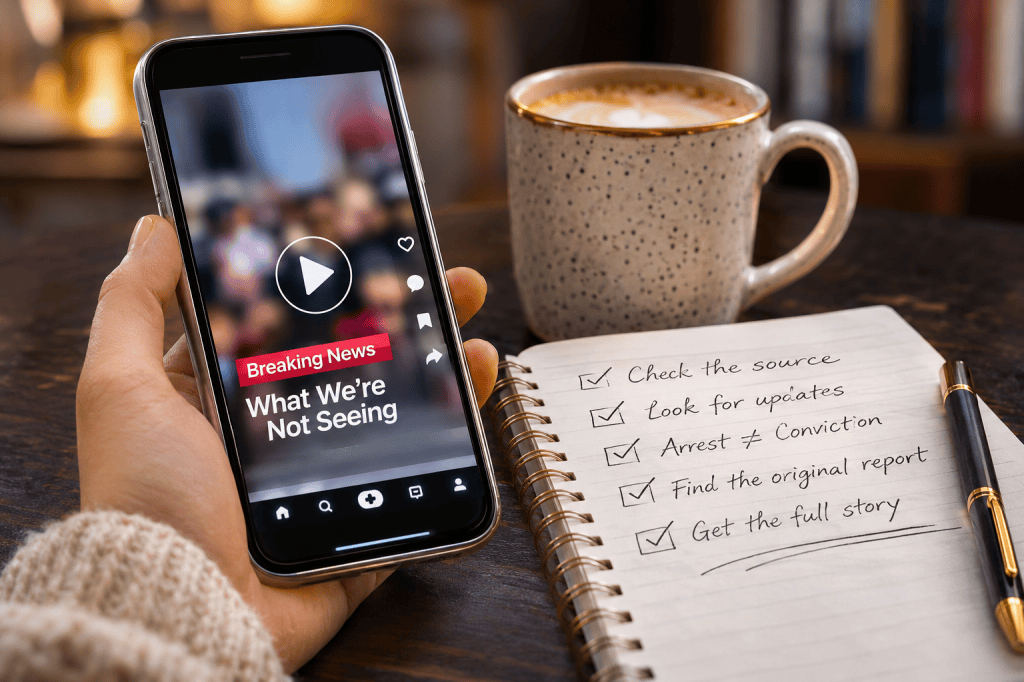
When a story catches your attention, look for the original reporting. Check the date. Find out whether the information comes from a public statement, a court filing, a named source, or someone repeating what someone else said. Look for updates. And pay attention to the language being used.
Was someone arrested, charged, convicted, or merely named in an allegation? Is the investigation ongoing? Has the information been confirmed by more than one reliable source?
Those questions may not make for the most exciting twenty seconds of your day, but they can keep you from sharing something that is inaccurate or unfair.
Curiosity is good. Context makes it useful.
There is nothing wrong with discovering the news through a short video. There is nothing wrong with creators making complicated subjects easier to understand. In fact, that kind of communication can be valuable.
But we should remember that a short video is often the beginning of understanding, not the finished product.
The goal is not to know everything about every headline. None of us has that kind of time, and frankly, I have laundry that would like a word.
The goal is to stay curious without confusing exposure with understanding.
Watch the video. Ask the question. Follow the story. Then take the extra minute to find out what actually happened.
Because being informed is not about being the first person to repeat a headline. It is about being thoughtful enough to understand what you are repeating.


Leave a Reply